The rules for posting are simple!

1. Every Friday post a photo that includes one or more flowers.
2. Please only post photos you have authority to use.
3. Include a link to this blog in your post - http://floralfridayfoto.blogspot.com/
4. Leave the link to your FloralFridayFoto post below on inlinkz.
5. Visit other blogs listed ... comment & enjoy!

When to Post:
inlinkz will be available every Thursday and will remain open until the next Wednesday.
Showing posts with label tree. Show all posts

Thursday, 18 December 2025

FFF730 - JACARANDA

Jacaranda mimosifolia is a sub-tropical tree native to South America that has been widely planted elsewhere because of its beautiful and long-lasting blue flowers. It is also known as Jacaranda, Blue Jacaranda, Black Poui, or as the fern tree. Older sources give it the systematic name Jacaranda acutifolia, but it is nowadays more usually classified as Jacaranda mimosifolia.

In scientific usage, the name "Jacaranda" refers to the genus Jacaranda, which has many other members, but in horticultural and everyday usage, it nearly always means the Blue Jacaranda. It is native to tropical and subtropical regions of the Americas while cultivated around the world. The flowers of some cultivars are lightly fragrant.

Join me for Floral Friday Fotos by linking your flower photos below, and please leave a comment once you have done so.
***If you take part in the meme, please show an active link back to this site on your own blog post!***


You are invited to the Inlinkz link party!

Click here to enter

Thursday, 11 September 2025

FFF716 - SWEET BAY

Laurus nobilis is an aromatic evergreen tree or large shrub with green, glabrous (smooth) leaves. It is in the flowering plant family Lauraceae. It is native to the Mediterranean region and is used as bay leaf for seasoning in cooking. Its common names include bay tree (esp. United Kingdom),  bay laurel, sweet bay, true laurel, Grecian laurel, or simply laurel.

Laurus nobilis figures prominently in classical Greco-Roman culture. The laurel plant and its wreath symbolise victory, honour, and achievement, with roots in Ancient Greek and Roman cultures where laurel wreaths were awarded to victors in athletic and military competitions.

The symbolism also extends to wisdom and the arts, as it was sacred to Apollo, and to poets crowned as "poets laureate". In modern times, the laurel wreath represents academic accomplishment at graduation: The Bachelors degree is from the Latin Baccalaureatus, meaning crowned with bay laurel. The wreath of laurel is also used to commemorate fallen soldiers.

Worldwide, many other kinds of plants in diverse families are also called "bay" or "laurel", generally due to similarity of foliage or aroma to Laurus nobilis.

Join me for Floral Friday Fotos by linking your flower photos below, and please leave a comment once you have done so.
If  you take part in the meme, please show an active link back to this site on your own blog post!


You are invited to the Inlinkz link party!

Click here to enter

Thursday, 28 August 2025

FFF714 - MAGNOLIA

Magnolia × soulangeana (saucer magnolia) is a hybrid plant in the genus Magnolia and family Magnoliaceae. It is a deciduous tree with large, early-blooming flowers in various shades of white, pink, and purple. It is one of the most commonly used magnolias in horticulture, being widely planted in the British Isles, especially in the south of England; in the United States, especially the east and west coasts, in the Southern parts of Australia and in New Zealand.

Illustrated here s the "Burgundy Star" hybrid. A stunning new variety with a distinctively upright, columnar form. Big, beautiful, and lightly fragrant flowers in a gorgeous shade of claret red, cover the tree in early spring. A spectacular specimen tree for most climates, tolerating all but the coldest temperatures.

Join me for Floral Friday Fotos by linking your flower photos below, and please leave a comment once you have done so.
If  you take part in the meme, please show an active link back to this site on your own blog post!


You are invited to the Inlinkz link party!

Click here to enter

Thursday, 10 July 2025

FFF707 - TIBOUCHINA

Tibouchina is a genus of about 350 species of neotropical plants in the family Melastomataceae. They are trees, shrubs or subshrubs growing 0.5–25 m tall, and are known as glory bushes or glory trees. They are native to rainforests of Mexico, the Caribbean, and South America, especially Brazil. The name comes from an adaptation of the native Guiana term for these shrubs.

In Brazil, people use the massed purple blooms to decorate churches at Easter time. Here in Australia tibouchinas also make quite a statement in autumn, with their riot of purple flowers. This particular plant is Tibouchina 'Alstonville', probably the best of the larger growing kinds, and common as a garden and street tree in Melbourne. This plant was produced at Alstonville, on the New South Wales North coast, by the late Ken Dunstan.

It is an evergreen small tree which usually grows to about 5m tall. The foliage is dark green in colour with a pale reverse. 'Alstonville' puts on a brilliant display of violet/purple flowers in late summer and autumn. It makes an excellent street or specimen tree, and responds very well to pruning. Join me for Floral Friday Fotos by linking your flower photos below, and please leave a comment once you have done so.
****If you take part in the meme, please show an active link back to this site on your own blog post, and please leave a comment!****

You are invited to the Inlinkz link party!

Click here to enter

Thursday, 12 June 2025

FFF703 - WILLOW-LEAF WATTLE

Acacia iteaphylla (F.Muell. ex Benth.) occurs naturally in South Australia extending from the Flinders Ranges across to the Gawler Ranges and the Eyre Peninsula. Commonly called Willow-leaf Wattle, this shapely decorative shrub is hardy and fast growing and flowers intermittently throughout the year with a peak flowering period in spring.

It is versatile in its habit growing to a height of 2-4 m with some forms becoming upright, whilst others are pendulous and bushy.The slender phyllodes of A. iteaphylla are from 50 -100 mm long and are broadly linear with a small gland at the base. They are blue-green in colour and arranged alternately, almost at right angles to the stems. The perfumed flower heads are produced in clusters of pale yellow balls which contrast pleasingly with the foliage. The buds are attractively enclosed by conspicuous pale, brown-tipped bracts. The flowers are followed by masses of flattened blue-green seed pods which become brown when mature.

A low growing form of A. iteaphylla has been recognised. It differs from other known forms in having low arching, slightly pendulous branches and grows to 0.5 m high by 4 m across. This plant, which originated as a variant in a batch of seedlings, has been registered as the cultivar Acacia 'Parsons Cascade'. To retain its low spreading growth habit the cultivar should be propagated only from cuttings as it will not necessarily breed true from seed.

Acacia iteaphylla grows best in a well drained sunny position. It is moderately frost tolerant and moderately salt tolerant. It can be propagated from cuttings taken between February and April. Seed germinates readily but should be scarified or treated with boiling water before sowing. Light pruning throughout the development of the plant will keep it vigorous and encourage bushiness. An application of a complete fertiliser in spring and a slow release fertiliser in autumn is also recommended.

Join me for Floral Friday Fotos by linking your flower photos below, and please leave a comment once you have done so.
If you take part in the meme, please show an active link back to this site on your own blog post!

You are invited to the Inlinkz link party!

Click here to enter

Thursday, 19 September 2024

FFF665 - JUDAS TREE

Cercis siliquastrum, commonly known as the Judas tree or Judas-tree, is a small deciduous tree in the flowering plant family Fabaceae which is noted for its prolific display of deep pink flowers in spring. It is native to Southern Europe and Western Asia.

There is a myth that Judas Iscariot hanged himself from a tree of this species, causing its white flowers to turn red. This belief is related to the common name 'Judas tree', which is possibly a corrupted derivation from the French common name, Arbre de Judée, meaning 'tree of Judea', referring to the hilly regions of that country where the tree used to be common. Another possible source for the vernacular name is the fact that the flowers and seedpods can dangle directly from the trunk in a way reminiscent of Judas's possible method of suicide.

This species forms a small tree up to 12 m in height and 10 m in width. The deep pink flowers are produced on year-old or older growth, including the trunk, in spring. They have five free petals and fused sepals, a flower shape typical of much of the pea family.

The leaves appear shortly after the first flowers emerge. These are cordate with a blunt apex and occasionally have a shallow notch at the tip. The tree produces long flat pods that hang vertically. The flowers are edible and reportedly have a sweet and tart taste.

Join me for Floral Friday Fotos by linking your flower photos below, and please leave a comment once you have done so!
***If you take part in the meme, please show an active link back to this site on your own blog post!****


You are invited to the Inlinkz link party!

Click here to enter

Thursday, 8 August 2024

FFF659 - WILD PLUM

A little early this year, the wild plum trees are blooming and `that means that Spring is not too far off in the Southern Hemisphere!

Prunus americana, commonly called the American plum or wild plum, is a species of Prunus native to North America from Saskatchewan to New Mexico east to New Hampshire and Florida. It has often been planted outside its core range and sometimes escapes cultivation. Many cultivated varieties have been derived from this species. It forms an excellent stock upon which to graft the domestic plum.

The wild plum grows as a large shrub or small tree, reaching up to 4.6 m. It is adapted to coarse- and medium-textured soils, but not to fine soils. The shrub is winter-hardy, but has little tolerance for shade, drought, or fire. Its growth is most active in spring and summer, and it blooms in midspring. It propagates by seed, but the rate of spread by seed is slow.

The wild plum is used for both ornamental and culinary purposes. The white flowers are decorative in spring and its short, single leader makes it a popular residential landscape tree. Sargent says of it: "As an ornamental plant P. americana has real value; the long wand-like branches form a wide, graceful head which is handsome in winter and in spring is covered with masses of pure white flowers followed by ample bright foliage and abundant showy fruit.

Join me for Floral Friday Fotos by linking your flower photos below, and please leave a comment once you have done so!
****If you take part in the meme, please show an active link back to this site on your own blog post!****

You are invited to the Inlinkz link party!

Click here to enter

Thursday, 18 July 2024

FFF656 - ALMOND BLOSSOM

The almond (Prunus dulcis, syn. Prunus amygdalus) is a species of tree in the Rosaceae family, native to the Middle East, the Indian Subcontinent and North Africa. "Almond" is also the name of the edible and widely cultivated seed of this tree. Within the genus Prunus, it is classified with the peach in the subgenus Amygdalus, distinguished from the other subgenera by the corrugated shell (endocarp) surrounding the seed.

The fruit of the almond is a drupe, consisting of an outer hull and a hard shell with the seed, which is not a true nut, inside. Shelling almonds refers to removing the shell to reveal the seed. Almonds are sold shelled or unshelled. Blanched almonds are shelled almonds that have been treated with hot water to soften the seedcoat, which is then removed to reveal the white embryo.

The almond is a deciduous tree, growing 4–10 m in height, with a trunk of up to 30 cm  in diameter. The young twigs are green at first, becoming purplish where exposed to sunlight, then grey in their second year. The leaves are 5 -10 long, with a serrated margin and a 2.5 cm petiole.The flowers are white to pale pink, 3–5 cm diameter with five petals, produced singly or in pairs and appearing before the leaves in late winter to early spring.

Almond grows best in Mediterranean climates with warm, dry summers and mild, wet winters. The optimal temperature for their growth is between 15 and 30 °C and the tree buds have a chilling requirement of 300 to 600 hours below 7.2 °C to break dormancy.  Almonds begin bearing an economic crop in the third year after planting. Trees reach full bearing five to six years after planting. The fruit matures in the autumn, 7–8 months after flowering.

Join me for Floral Friday Fotos by linking your flower photos below, and please leave a comment once you have done so!
****If you take part in the meme, please show an active link back to this site on your own blog post!****


You are invited to the Inlinkz link party!

Click here to enter

Thursday, 9 May 2024

FFF646 - YELLOW GUM 'ROSEA'

Eucalyptus leucoxylon, commonly known as the Yellow Gum, (South Australian) Blue Gum or White Ironbark, is a small to medium-sized tree with rough bark on the lower 1-2 metres of the trunk, above this, the bark becomes smooth with a white, yellow or bluish-grey surface. Adult leaves are stalked, lanceolate to broad-lanceolate, to 13 x 2.5 cm, concolorous, dull, green. Flowers in white, pink or red appear during winter. 

E. leucoxylon is widely distributed on plains and nearby mountain ranges or coastal South Australia, where it is known as the Blue Gum and extends into the western half of Victoria where it is known as the Yellow gum. The species has been divided into numerous varieties and subspecies. A spectacular red-flowered form of uncertain provenance Eucalyptus leucoxylon ‘Rosea’ (shown here) is widely planted as an ornamental plant, it flowers profusely in winter.

Join me for Floral Friday Fotos by linking your flower photos below, and please leave a comment once you have done so.
***If you take part in the meme, please show an active link back to this site on your own blog post!***

You are invited to the Inlinkz link party!

Click here to enter

Thursday, 5 October 2023

FFF615 - GRAPEFRUIT FLOWERS

The grapefruit (Citrus × aurantium f. aurantium, Syn: Citrus × paradisi) is a subtropical citrus tree known for its relatively large, sour to semi-sweet, somewhat bitter fruit. The interior flesh is segmented and varies in colour from pale yellow to dark pink/red.

Grapefruit is a citrus hybrid that originated in Barbados in the 18th century. It is an accidental cross between the sweet orange (C. × sinensis) and the pomelo or shaddock (C. maxima), both of which were introduced from Asia in the 17th century. It has also been called the forbidden fruit. In the past it was referred to as the pomelo, but that term is now mostly used as the common name for Citrus maxima.

In 2021, world production of grapefruits (combined with pomelos) was 9.6 million tonnes, with China contributing 54% of the total.

The evergreen grapefruit trees usually grow to around 5–6 m tall, although they may reach 13–15 m. The leaves are long (up to 15 cm), thin, glossy, and dark green. They produce 5 cm white four-petaled flowers. The fruit is yellow-orange skinned and generally an oblate spheroid in shape; it ranges in diameter from 10 to 15 cm. Its flesh is segmented and acidic, varying in colour depending on the cultivars, which include white, pink, and red pulps of varying sweetness (generally, the redder varieties are the sweetest).

Join me for Floral Friday Fotos by linking your flower photos below, and please leave a comment once you have done so!
****If you take part in the meme, please show an active link back to this site on your own blog post!****

You are invited to the Inlinkz link party!

Click here to enter

Thursday, 17 August 2023

FFF608 - MAGNOLIA 'BLACK TULIP'

Magnolia 'Black Tulip' (Magnolia x soulangeana a hybrid developed in New Zealand and is a cross between Magnolia 'Vulcan' and Magnolia 'Iolanthe'. It makes an excellent feature tree in any garden with its magnificent deep burgundy to near black blooms up to 15cm across. Flowers appear on bare stems in early Spring and are followed by beautiful green foliage.
They are frost-hardy deciduous small trees, and they show off their large goblet-shaped, fragrant blooms on bare branches in late Winter to early Spring, followed by large green leaves that will eventually become shades of gold in Autumn.
It is hard to find a more spectacular sight than a Magnolia in full bloom; these beautiful trees perform best in cooler climates and grow into a better shape (and flower for longer periods of time) with protection from strong winds. Snails love the delicate flowers so keep an eye out for these troublesome pests at flowering time.
The 'Black Tulip' is a great option for smaller gardens or as a specimen tree. It reaches a mature height of 8-10 meters and width of 6-8 meters, making it the perfect size for a range of garden spaces. The tree is also great for adding interest to any landscape, with its striking flowers and unique colour. It is deciduous, and the dark green leaves and smooth, grey bark add to its beauty. It's low maintenance and adaptable to various soil types, preferring well-draining, acidic soils.

Join me for Floral Friday Fotos by linking your flower photos below, and please leave a comment once you have done so!
If you link your post here, please show a link back to this site on your blog post.

You are invited to the Inlinkz link party!

Click here to enter

Thursday, 27 July 2023

FFF605 - COASTAL BANKSIA

Banksia integrifolia, commonly known as the coast banksia, is a species of tree that grows along the east coast of Australia. One of the most widely distributed Banksia species, it occurs between Victoria and Central Queensland in a broad range of habitats, from coastal dunes to mountains. It is highly variable in form, but is most often encountered as a tree up to 25 metres in height.

Its leaves have dark green upper surfaces and white undersides, a contrast that can be striking on windy days. It is one of the four original Banksia species collected by Sir Joseph Banks in 1770, and one of four species published in 1782 as part of Carolus Linnaeus the Younger's original description of the genus. It has had a complicated taxonomic history, with numerous species and varieties ascribed to it, only to be rejected or promoted to separate species. Modern taxonomy recognises three subspecies: B. integrifolia subsp. integrifolia, B. integrifolia subsp. compar and B. integrifolia subsp. monticola.

A hardy and versatile garden plant, B. integrifolia is widely planted in Australian gardens. It is a popular choice for parks and streetscapes, and has been used for bush revegetation and stabilisation of dunes. Its hardiness has prompted research into its suitability for use as a rootstock in the cut flower trade, but has also caused concerns about its potential to become a weed outside its natural habitat.

Join me for Floral Friday Fotos by linking your flower photos below, and please leave a comment once you have done so!
****If you take part in the meme, please show an active link back to this site on your own blog post!****


You are invited to the Inlinkz link party!

Click here to enter

Thursday, 22 June 2023

FFF600 - CLOVE FLOWERS

Cloves are the aromatic flower buds of a tree in the family Myrtaceae, Syzygium aromaticum. They are native to the Maluku Islands (Moluccas) in Indonesia, and are commonly used as a spice, flavouring, or fragrance in consumer products, such as toothpaste, soaps, or cosmetics. Cloves are available throughout the year owing to different harvest seasons across various countries.

The clove tree is an evergreen that grows up to 8–12 metres tall, with large leaves and crimson flowers grouped in terminal clusters. The flower buds initially have a pale hue, gradually turn green, then transition to a bright red when ready for harvest. Cloves are harvested at 1.5–2 centimetres long, and consist of a long calyx that terminates in four spreading sepals, and four unopened petals that form a small central ball.

Clove stalks are slender stems of the inflorescence axis that show opposite decussate branching. Externally, they are brownish, rough, and irregularly wrinkled longitudinally with short fracture and dry, woody texture.

Mother cloves (anthophylli) are the ripe fruits of cloves that are ovoid, brown berries, unilocular and one-seeded. Blown cloves are expanded flowers from which both corollae and stamens have been detached. Exhausted cloves have most or all the oil removed by distillation. They yield no oil and are darker in colour.

Join me for Floral Friday Fotos by linking your flower photos below, and please leave a comment once you have done so.
****If you take part in the meme, please show an active link back to this site on your own blog post!***


You are invited to the Inlinkz link party!

Click here to enter

Thursday, 9 February 2023

FFF581 - JUJUBE FLOWERS

Jujube, sometimes jujuba, known by the scientific name Ziziphus jujuba and also called red date, Chinese date, and Chinese jujube, is a species in the genus Ziziphus in the buckthorn family Rhamnaceae.

It is a small deciduous tree or shrub reaching a height of 5–12 metres, usually with thorny branches. The leaves are shiny-green, ovate-acute, 2–7 centimetres long and 1–3 cm wide, with three conspicuous veins at the base, and a finely toothed margin. The flowers are small, 5 millimetres wide, with five inconspicuous yellowish-green petals.

The fruit is an edible oval drupe 1.5–3 cm deep; when immature it is smooth-green, with the consistency and taste of an apple with lower acidity, maturing brown to purplish-black, and eventually wrinkled, looking like a small date. There is a single hard kernel, similar to an olive pit, containing two seeds.

The freshly harvested, as well as the candied dried fruit, are often eaten as a snack, or with coffee. Smoked jujubes are consumed in Vietnam and are referred to as black jujubes. A drink can be made by crushing the pulp in water. Both China and Korea produce a sweetened tea syrup containing jujube fruit in glass jars, and canned jujube tea or jujube tea in the form of teabags. To a lesser extent, jujube fruit is made into juice and jujube vinegar (called 枣 醋 or 红枣 醋 in Chinese). They are used for making pickles (কুলের আচার) in west Bengal and Bangladesh. In Assam it is known as "Bogori" and is famous for Bogori aachar (বগৰি আচাà§°). In China, a wine made from jujube fruit is called hong zao jiu (红枣酒).

Join me for Floral Friday Fotos by linking your flower photos below, and please leave a comment once you have done so!
***If you take part in the meme, please show an active link back to this site on your own blog post!****


You are invited to the Inlinkz link party!

Click here to enter

Thursday, 5 January 2023

FFF576 - NORFOLK ISLAND HIBISCUS

Lagunaria is a monotypic genus in the family Malvaceae. It is an Australian plant endemic to Lord Howe Island, Norfolk Island and parts of coastal Queensland. It has been introduced to many parts of the world. The genus was named in honour of Andrés Laguna, a Spanish botanist and a physician to Pope Julius III. It now consists of the single species Lagunaria patersonia, commonly known as the Pyramid Tree or Norfolk Island Hibiscus. It is not a true Hibiscus, however, but does belong to the same plant family, Malvaceae.

Recently, L. queenslandica from north-east Queensland has been recognised. The latter was previously regarded as L. patersonia subsp. bracteata but has been raised to species status on the basis of morphological and ecological differences. L. patersonia also is more robust in habit and has larger, scaly leaves. The two species also differ in their habitats with L. patersonia generally occurring in rainforest while L. queenslandica is found in non-rainforest areas often along rivers and creeks.

Norfolk Island hibiscus is a medium to large tree which can reach about 12-20 metres in height. It has dense, greyish-green leaves which are oval shaped to about 100 mm long and covered in soft hairs when young. The pink flowers are of typical hibiscus shape and appear in the leaf axils in spring and early summer. They are generally a pink to mauve but deeper coloured forms are in cultivation. These trees are often planted along Melbourne streets and in parks and when in flower can be quite spectacular.

The seed capsules are filled with irritating hairs giving rise to another common name, Cow Itch Tree. The "cow" part however appears to be a misnomer. In many parts of Australia, Lagunaria is considered a pest, and is commonly referred to as the Itchy Bomb Tree due to the tiny, almost invisible, hairs inside the seed pods which, if the seeds pods are split open, can lodge in the skin like tiny barbs of broken glass, causing a great deal of pain.

Join me for Floral Friday Fotos by linking your flower photos below, and please leave a comment once you have done so!
****If you take part in the meme, please show an active link back to this site on your own blog post!****


You are invited to the Inlinkz link party!

Click here to enter

Thursday, 8 December 2022

FFF572 - JACARANDA

Jacaranda mimosifolia is a sub-tropical tree native to South America that has been widely planted elsewhere because of its beautiful and long-lasting blue flowers. It is also known as Jacaranda, Blue Jacaranda, Black Poui, or as the fern tree. Older sources give it the systematic name Jacaranda acutifolia, but it is nowadays more usually classified as Jacaranda mimosifolia. In scientific usage, the name "Jacaranda" refers to the genus Jacaranda, which has many other members, but in horticultural and everyday usage, it nearly always means the Blue Jacaranda.

Join me for Floral Friday Fotos by linking your flower photos below, and please leave a comment once you have done so.
***If you take part in the meme, please show an active link back to this site on your own blog post!***

You are invited to the Inlinkz link party!

Click here to enter

Thursday, 20 October 2022

FFF565 - DOGWOOD

Cornus is a genus of about 30–60 species of woody plants in the family Cornaceae, commonly known as dogwoods, which can generally be distinguished by their blossoms, berries, and distinctive bark. Most are deciduous trees or shrubs, but a few species are nearly herbaceous perennial subshrubs, and a few of the woody species are evergreen. Several species have small heads of inconspicuous flowers surrounded by an involucre of large, typically white petal-like bracts, while others have more open clusters of petal-bearing flowers. 

The various species of dogwood are native throughout much of temperate and boreal Eurasia and North America, with China and Japan and the southeastern United States particularly rich in native species. Species include the common dogwood Cornus sanguinea of Eurasia, the widely cultivated flowering dogwood (Cornus florida) of eastern North America, the Pacific dogwood Cornus nuttallii of western North America, the Kousa dogwood Cornus kousa of eastern Asia, and two low-growing boreal species, the Canadian and Eurasian dwarf cornels (or bunchberries), Cornus canadensis and Cornus suecica respectively.

Depending on botanical interpretation, the dogwoods are variously divided into one to nine genera or subgenera.

Join me for Floral Friday Fotos by linking your flower photos below, and please leave a comment once you have done so.
**If you take part in the meme, please show an active link back to this site on your own blog post!***

You are invited to the Inlinkz link party!

Click here to enter

Thursday, 15 September 2022

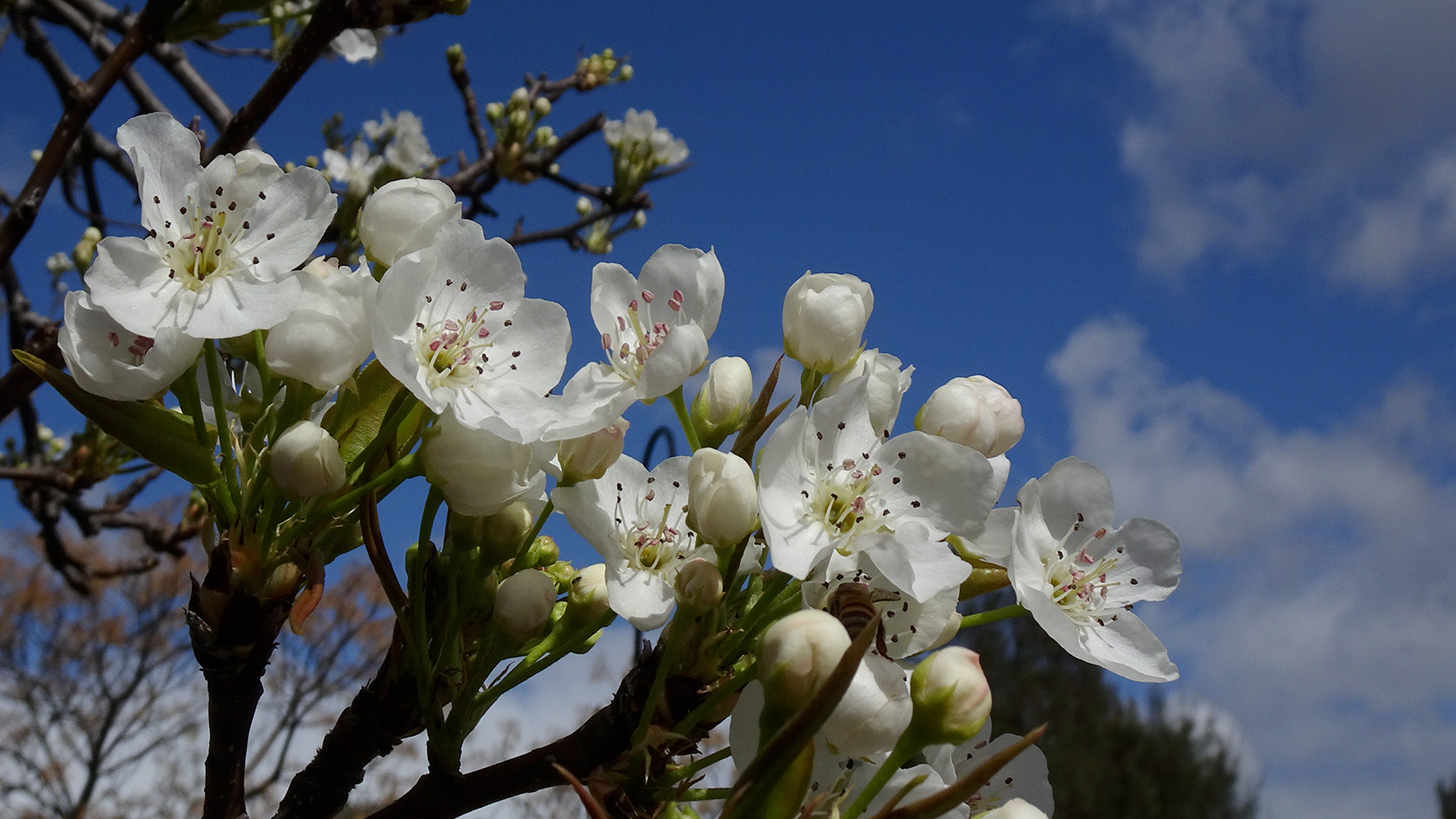
FFF560 - CALLERY PEAR

Pyrus calleryana, the Callery pear known in the USA as the Bradford Pear, is a species of pear native to China and Vietnam, in the family Rosaceae. It is a deciduous tree growing to 5 to 8 m tall, often with a conic to rounded crown. The leaves are oval, 4 to 8 cm long, glossy dark green above, and slightly paler below. 

The white, five-petaled flowers are about 2 to 2.5 cm in diameter. They are produced abundantly in early spring, before the leaves expand fully. The fruits of the Callery pear are small (less than one cm in diameter), and hard, almost woody, until softened by frost, after which they are readily taken by birds, which disperse the seeds in their droppings.

In summer, the foliage is dark green and very smooth, and in autumn the leaves commonly turn brilliant colours, ranging from yellow and orange to more commonly red, pink, purple, and bronze. Their dense clusters of white blossoms are conspicuous and very pretty in early spring, however their smell is commonly found unpleasant by many people (me included!). The smell is often described as 'fishy' and 'putrid'.

Join me for Floral Friday Fotos by linking your flower photos below, and please leave a comment once you have done so!
****If you take part in the meme, please show an active link back to this site on your own blog post!****


You are invited to the Inlinkz link party!

Click here to enter

Thursday, 1 September 2022

FFF558 - PURPLE-LEAF PLUM

Prunus cerasifera 'Atropurpurea' is a shrub to a small tree in the rose family that grows 15-25 feet tall and wide with a vase to a rounded shape. The reddish-purple leaves are the attraction to this plant along with the showy white to pink spring flowers, with a honey-like fragrance. The leaves maintain their colour most of the year. They are fairly short-lived and susceptible to insects and diseases. Twigs and fruit drop can be messy. Purpleleaf plum isn't picky about soil type or pH and is moderately drought tolerant once established. Leaf colour is best when grown in full sun.

The tree porduces 2 to 4 cm fleshy fruits, which are reddish-purple drupes. They are produced prolifically and are edible by wildlife and humans. They make excellent jam and can be pickled.

Join me for Floral Friday Fotos by linking your flower photos below, and please leave a comment once you have done so!
****If you take part in the meme, please show an active link back to this site on your own blog post!****

You are invited to the Inlinkz link party!

Click here to enter

Thursday, 30 December 2021

FFF525 - CURRY TREE

The curry tree, Murraya koenigii or Bergera koenigii, is a tropical to sub-tropical tree in the family Rutaceae (the rue family, which includes rue, citrus, and satinwood), and is native to Asia. The plant is also sometimes called sweet neem, though M. koenigii is in a different family to neem, Azadirachta indica, which is in the related family Meliaceae. Its leaves, known as curry leaves, are used in many dishes in the Indian subcontinent.

Join me for Floral Friday Fotos by linking your flower photos below, and please leave a comment once you have done so.
If you take part in the meme, please show an active link back to this site on your own blog post!


You are invited to the Inlinkz link party!

Click here to enter