The rules for posting are simple!

1. Every Friday post a photo that includes one or more flowers.
2. Please only post photos you have authority to use.
3. Include a link to this blog in your post - http://floralfridayfoto.blogspot.com/
4. Leave the link to your FloralFridayFoto post below on inlinkz.
5. Visit other blogs listed ... comment & enjoy!

When to Post:
inlinkz will be available every Thursday and will remain open until the next Wednesday.
Showing posts with label red. Show all posts

Thursday, 24 April 2025

FFF696 - CAMELLIA SASANQUA 'YULETIDE'

Camellia Sasanqua 'Yuletide' (Camellia x vernalis 'Yuletide') has small, bright red, single flowers, with prominent golden yellow stamens, and is known to attract nectar feeding birds to your garden. It is a strong, upright growing shrub that is long living and can grow into a small tree. It makes a wonderful hedge or espalier. It will grow in most areas except for the hot tropics and inland. If you have slightly acidic soil, this is the plant for you.

Join me for Floral Friday Fotos by linking your flower photos below, and please leave a comment once you have done so.
If you take part in the meme, please show an active link back to this site on your own blog post!


You are invited to the Inlinkz link party!

Click here to enter

Thursday, 1 August 2024

FFF658 - ADONIS

Adonis aestivalis, the summer pheasant's-eye, is a medicinal and ornamental plant. It is native to Europe and Asia but has been introduced elsewhere, such as the western and eastern parts of the United States, as an ornamental plant. In particular, it has been known to invade alfalfa fields, contaminating feed used for horse hay. It is a member of the buttercup family, Ranunculaceae.

It is an annual herb that grows up to 1 m tall. The stems are erect with simple, pinnately-dissected, alternate leaves and a small, terminal flower. The flowers are perfect. The radially symmetrical flowers are an orange to red colour, and each petal has a black splotch at its base. Its petals curl to form a cup-like shape. The fruit is an achene. A single flower can produce 50 to 100 seeds.

A. aestivalis has been used in European folk medicine to treat weak hearts by stimulating cardiac activity. The plant is dried out and combined with some water to form a tonic. It can be toxic at large doses, causing paralysis of the heart muscles. It is also used to treat coughs and spasms and as a diuretic and sleeping aid. It has also been used in Iran to treat rheumatism and heart disease.

Join me for Floral Friday Fotos by linking your flower photos below, and please leave a comment once you have done so!
****If you take part in the meme, please show an active link back to this site on your own blog post!****

You are invited to the Inlinkz link party!

Click here to enter

Thursday, 30 May 2024

FFF649 - STURT'S DESERT PEA

Swainsona formosa, commonly known as Sturt's desert pea or Sturt pea, is a species of flowering plant in the family Fabaceae and is native to all continental states and the Northern Territory of Australia, with the exception of Victoria. It is a prostrate annual or short lived perennial herb with imparipinnate leaves with about 15 elliptic to egg-shaped leaflets with the narrower end towards the base, and racemes of usually red flowers in racemes of 2 to 6.

Swainsona formosa is a prostrate annual or short lived perennial herb, with several densely softly-hairy stems mostly 4–8 mm wide. The leaves are mostly 100–150 mm  long with about 15 elliptic to egg-shaped leaflets 100–300 mm  long and 5–12 mm wide, the end leaflet slightly longer. There are broad, densely hairy stipules, sometimes 15 mm or more at the base of the petiole. The flowers are borne in racemes about 100–150 mm  long with 2 to 6 usually red flowers, sometimes white or other colours, on a peduncle 50–150 mm ong, each flower on a shaggy-hairy pedicel 5–20 mm long.

Sturt's desert pea is widespread in arid parts of inland Australia, including in Western Australia, South Australia, the southern parts of the Northern Territory, western parts of New South Wales and in Queensland. It grows in red sandy or loamy soils in mulga woodland, near creek lines and on stony hills, sometimes in woodland and open plains.

Join me for Floral Friday Fotos by linking your flower photos below, and please leave a comment once you have done so.
***If you take part in the meme, please show an active link back to this site on your own blog post!***

You are invited to the Inlinkz link party!

Click here to enter

Thursday, 9 May 2024

FFF646 - YELLOW GUM 'ROSEA'

Eucalyptus leucoxylon, commonly known as the Yellow Gum, (South Australian) Blue Gum or White Ironbark, is a small to medium-sized tree with rough bark on the lower 1-2 metres of the trunk, above this, the bark becomes smooth with a white, yellow or bluish-grey surface. Adult leaves are stalked, lanceolate to broad-lanceolate, to 13 x 2.5 cm, concolorous, dull, green. Flowers in white, pink or red appear during winter. 

E. leucoxylon is widely distributed on plains and nearby mountain ranges or coastal South Australia, where it is known as the Blue Gum and extends into the western half of Victoria where it is known as the Yellow gum. The species has been divided into numerous varieties and subspecies. A spectacular red-flowered form of uncertain provenance Eucalyptus leucoxylon ‘Rosea’ (shown here) is widely planted as an ornamental plant, it flowers profusely in winter.

Join me for Floral Friday Fotos by linking your flower photos below, and please leave a comment once you have done so.
***If you take part in the meme, please show an active link back to this site on your own blog post!***

You are invited to the Inlinkz link party!

Click here to enter

Thursday, 2 November 2023

FFF619 - RED ORCHID CACTUS

Disocactus is a genus of epiphytic cacti in the tribe Hylocereeae found in Central America, the Caribbean and northern South America. It should not be confused with Discocactus, which is a different genus. Species of Disocactus grow in tropical regions either on trees as epiphytes or on rocks as lithophytes.

They have two distinct growth habits. Species such as D. phyllanthoides have stems which are round at the base but then become flattened and leaflike. Many of the cultivated plants known as epiphyllum hybrids or just epiphyllums are derived from crosses between species of Disocactus (rather than Epiphyllum) and other genera in the Hylocereeae.

The one illustrated here is blooming in our garden at the moment and is probably a Disocactus × jenkinsonii is a hybrid between Disocactus phyllanthoides and Disocactus speciosus. It is perhaps the most commonly grown orchid cactus and seems to survive and flower under most conditions. It has a very complex taxonomic history and has been mistaken for Disocactus ackermannii for a long time.

Join me for Floral Friday Fotos by linking your flower photos below, and please leave a comment once you have done so!
****If you take part in the meme, please show an active link back to this site on your own blog post!****

You are invited to the Inlinkz link party!

Click here to enter

Thursday, 19 October 2023

FFF617 - AZTEC LILY

Sprekelia is a genus of at least three bulbous plants in the family Amaryllidaceae, subfamily Amaryllidoideae. They are native to Central America. Like Hippeastrum, these plants were known as Amaryllis. Sprekelia plants are sometimes called "Aztec lilies", although they are not true lilies. This genus is named after Johann Heinrich von Spreckelsen (1691–1764), who supplied the plants to Lorenz Heister.

Sprekelia formosissima shown here is the only species grown in Australia. It is a bulbous perennial that has clumps of strap-shaped, mid-green leaves. Each stem, about 30 cm tall, bears a solitary scarlet to deep crimson flower in late spring or early summer; established clumps may bloom again later in the summer. It grows best in partial sun and abundant moisture. Because the bulbs are tender and bloom best when crowded, container culture is probably best. Repot every 2 to 3 years. Roots resent disturbance.

Join me for Floral Friday Fotos by linking your flower photos below, and please leave a comment once you have done so!
****If you take part in the meme, please show an active link back to this site on your own blog post!****

You are invited to the Inlinkz link party!

Click here to enter

Thursday, 4 May 2023

FFF593 - HAEMANTHUS

Haemanthus coccineus (commonly known as the Blood Flower or Paintbrush Lily), is a bulbous geophyte in the genus Haemanthus, native to Southern Africa. The generic name Haemanthus is derived from the Greek words haima for "blood" and anthos for "flower"; coccineus is the Latin word for red or scarlet. In the Afrikaans language it is known as Bergajuin, Bloedblom, and many other vernacular names.

The Blood Lily is native throughout the winter rainfall region in Southern Africa - from the southern parts of Namibia, to South Africa in the Cape Peninsula, to the Keiskamma River in the Eastern Cape. It is an adaptable species, growing in a wide range of soils derived from sandstones, quartzites, granites, shales and limestones. It will survive annual rainfall ranging from 100–1,100 millimetres.

The large (up to 10 cm diameter) flowerheads of Haemanthus coccineus emerge between February and April in the Southern Hemisphere, with scarlet spathe valves on them like bright shaving brushes, making it a striking plant. The flowers are soon followed by translucent, fleshy berries. There are usually two very large leaves per bulb, and occasionally three, these leaves appearing only after flowering has occurred.

We have it growing in our garden quite happily and it always attracts a lot of attention when it is in bloom.

Join me for Floral Friday Fotos by linking your flower photos below, and please leave a comment once you have done so.
****If you take part in the meme, please show an active link back to this site on your own blog post!***


You are invited to the Inlinkz link party!

Click here to enter

Thursday, 30 March 2023

FFF588 - RED CAMELLIA

Camellia is a genus of flowering plants in the family Theaceae. They are found in eastern and southern Asia, from the Himalayas east to Japan and Indonesia. There are 100–250 described species, with some controversy over the exact number. The genus was named by Linnaeus after the Jesuit botanist Georg Joseph Kamel, who worked in the Philippines, though he never described a camellia.

This genus is famous throughout East Asia; camellias are known as cháhuā (茶花) in Chinese, "tea flower", an apt designation, as tsubaki (椿) in Japanese, as dongbaek-kkot (동백꽃) in Korean and as hoa trà or hoa chè in Vietnamese. Of economic importance in the Indian subcontinent and Asia, leaves of C. sinensis are processed to create the popular beverage, tea. The ornamental Camellia japonica, Camellia oleifera and Camellia sasanqua and their hybrids are represented in cultivation by a large number of cultivars.

Join me for Floral Friday Fotos by linking your flower photos below, and please leave a comment once you have done so! 
***If you take part in the meme, please show an active link back to this site on your own blog post!****

You are invited to the Inlinkz link party!

Click here to enter

Thursday, 29 September 2022

FFF562 - GIANT SPEAR LILY

Doryanthes is the sole genus in the flowering plant family Doryanthaceae. The genus consists of two species, D. excelsa and D. palmeri, both native to the coast of Eastern Australia. Plants grow in a rosette form, only flowering after more than 10 years. They enjoy a warm environment, good soil, and much water during the warmest time of the year.

The genus Doryanthes was first described in 1802 by the Portuguese priest, statesman, philosopher and botanist José Francisco Corrêa da Serra (1751–1823), a close friend of Joseph Banks. Doryanthes excelsa or "Gymea Lily", endemic to southern Sydney and the Illawarra. The family Doryanthaceae, placed in the order Asparagales of the monocots, has only recently been recognised by taxonomists. Formerly the genus was usually placed in the family Agavaceae.

Doryanthes palmeri (the Giant Spear Lily), shown here, grows in a rosette and the leaves can reach the length of about 3 m. The flowers arise in springtime on a stalk which may reach 5 m in height. A succulent herb, its leaves are hairless and grow in the shape of a sword. The Giant Spear Lily is listed as 'vulnerable' under the New South Wales Threatened Species Act (1995). Here it is seen growing in Melbourne's Fitzroy Gardens, close to the Conservatory.

Join me for Floral Friday Fotos by linking your flower photos below, and please leave a comment once you have done so!
****If you take part in the meme, please show an active link back to this site on your own blog post!****


You are invited to the Inlinkz link party!

Click here to enter

Thursday, 21 July 2022

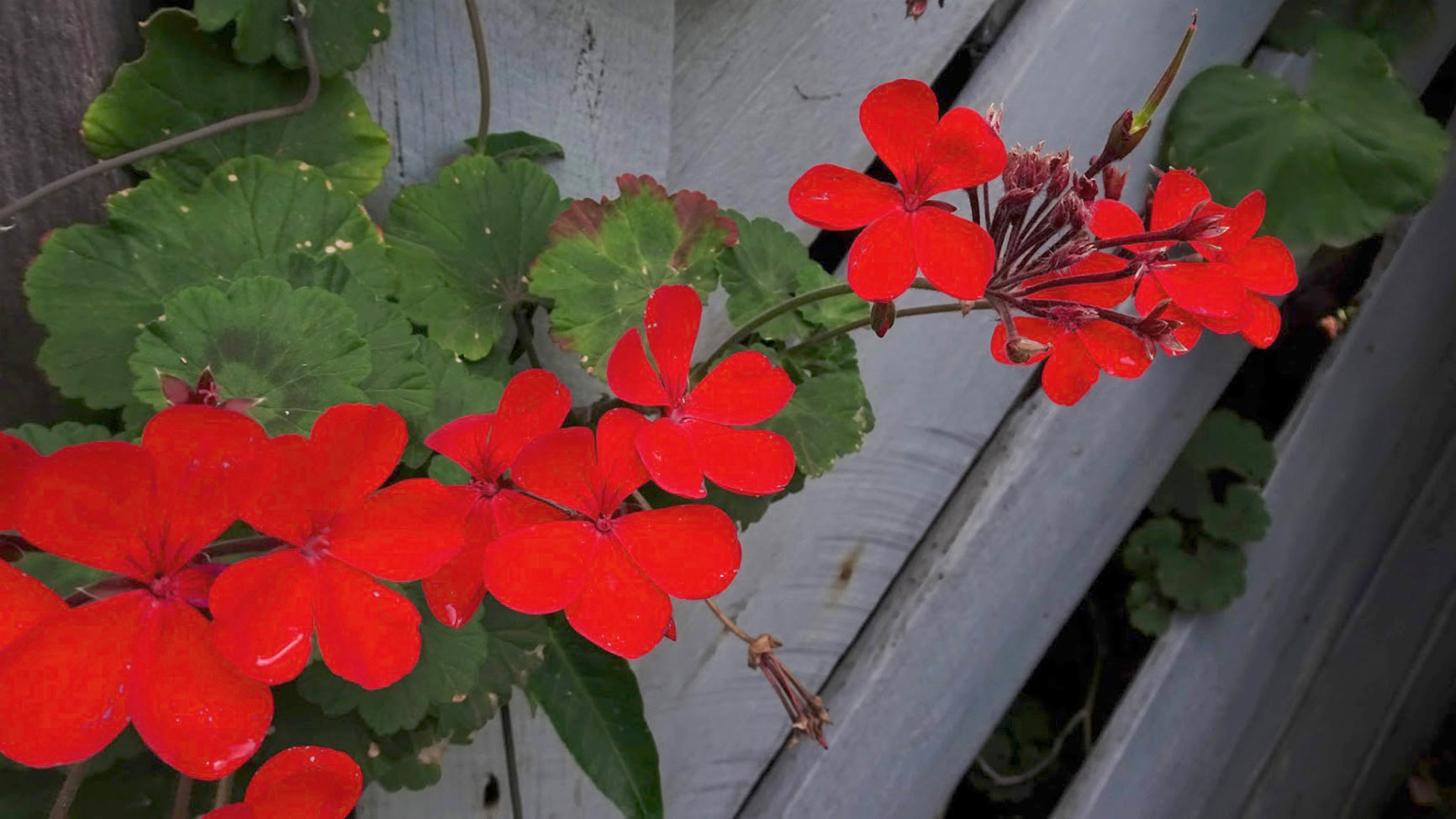
FFF552 - RED GERANIUM

Pelargonium x garden is also known as the common geranium, zonal geranium or bedding geranium and is a common species in the Geraniaceae Family. This species of geranium is most commonly used as an ornamental plant. Hybrids include the usual nursery "seed-grown" and the "cutting grown", which can easily be grown at home by cutting and planting side branches.

Join me for Floral Friday Fotos by linking your flower photos below, and please leave a comment once you have done so.

You are invited to the Inlinkz link party!

Click here to enter

Thursday, 26 May 2022

FFF546 - TECOMA

Tecoma capensis (common name Cape honeysuckle) is a species of flowering plant in the family Bignoniaceae, native to southern Africa. Despite its common name, it is not closely related to the true honeysuckle. Synonyms include Bignonia capensis, Tecomaria capensis and Tecoma petersii. An erect, scrambling shrub, it grows to 2–3 m in height and a similar width. Normally evergreen, it may lose its leaves in colder climates. In certain habitats it may scramble, meaning that it shoots out long growth tips which lean on the stems and branches of other plants, as well as boulders, trellises, fences and walls; this can lead to the plant appearing untidy.

The leaves are up to 15 cm long. They are opposite, slightly serrated, green to dark-green, and pinnate with 5 to 9 oblong leaflets. The flowers are tubular, narrow, about 7.5 cm long, and are produced at different times throughout the year. They are grouped in 10–15 cm long terminal clusters. The flower colour ranges from orange to orange-red to apricot.

The species occurs naturally in South Africa, Swaziland and southern Mozambique. It is cultivated in other areas of the world, such as in South-east Asia, Australia, Hawaii and California. It can be considered invasive in remote islands such as the Azores (as seen at the island of São Miguel, near Ponta Garça).

Tecoma capensis has been in cultivation for many years and is often used for hedging, as it is a scrambling shrub. It can be propagated from cuttings or by removing rooted suckers during the active growth phase. It can be planted in semi-shade to full sun. In cold areas young plants should be protected from frost. To keep this shrub clean and tidy, it must be pruned back in late winter to promote new growth and flowers. The application of a balanced fertilizer after pruning will enhance the growth and flowering. This plant has gained the Royal Horticultural Society's Award of Garden Merit.

Join me for Floral Friday Fotos by linking your flower photos below, and please leave a comment once you have done so! If you link your post here, please show a link back to this site on your blog post...


You are invited to the Inlinkz link party!

Click here to enter

Thursday, 7 April 2022

FFF539 - GEUM

Geum, commonly called avens, is a genus of about 50 species of rhizomatous perennial herbaceous plants in the rose family Rosaceae, native to Europe, Asia, North and South America, Africa, and New Zealand. They are closely related to Potentilla and Fragaria.

From a basal rosette of leaves they produce flowers on wiry stalks, in shades of red, yellow and orange, in midsummer. Geum species are evergreen except where winter temperatures drop below −18 °C. The cultivars "Lady Stratheden" and "Mrs J. Bradshaw" have gained the Royal Horticultural Society's Award of Garden Merit.

Join me for Floral Friday Fotos by linking your flower photos below, and please leave a comment once you have done so!

You are invited to the Inlinkz link party!

Click here to enter

Thursday, 31 March 2022

FFF538 - HONEY FLOWER

Melianthus major (giant honey flower or Kruidjie-roer-my-nie) is a species of flowering plant in the family Melianthaceae. It is an evergreen suckering shrub, endemic to South Africa and naturalised in India, Australia and New Zealand. It grows to 2–3 m tall by 1–3 m wide, with pinnate blue-green leaves 30–50 cm long, which have a distinctive, unpleasant odour.

Dark red, nectar-laden flower spikes, 30–80 cm in length, appear in spring, followed by green pods. All parts of the plants are poisonous. The Latin binomial Melianthus major literally means "large honey flower". In cultivation this plant requires a sheltered location and may also need a protective winter mulch in temperate regions. It has gained the Royal Horticultural Society's Award of Garden Merit.

Join me for Floral Friday Fotos by linking your flower photos below, and please leave a comment once you have done so!

You are invited to the Inlinkz link party!

Click here to enter

Thursday, 21 October 2021

FFF515 - NSW CHRISTMAS BUSH

Ceratopetalum gummiferum, the New South Wales Christmas Bush, is a tall shrub or small tree popular in cultivation due to its sepals that turn bright red-pink at around Christmas time. The petals are actually small and white - it is the sepals that enlarge to about 12mm after the flower sets fruit and starts to dry out. The specific name gummiferum alludes to the large amounts of gum that is discharged from cut bark. 

Plants initially grow as rounded shrubs but mature to pyramidical trees. The leaves comprise three leaflets and are up to 8 cm long. The petioles are grooved on the upper side and are 10 to 20 mm long. Small, white five-petalled flowers appear in spays from October in the species native range. As these die the sepals enlarge and become pink to red in colour, the display peaking at Christmas time in Australia (i.e. during Summer).

Ceratopatalum gummiferum is one of nine species in the genus Ceratopetalum in the family Cunoniaceae, which occur in Australia and Papua New Guinea. The species was first formally described by English botanist James Edward Smith in 1793 in 'A Specimen of the Botany of New Holland'. The species is endemic to New South Wales where it occurs to the east of the Great Dividing Range from Ulladulla in the south to Evans Head in the north.

In cultivation, plants usually grow to no more than 6 metres in height. Plants may be propagated from seed or cuttings, the latter method being preferred to maintain good colour forms. Well-drained soil is required to avoid problems with dieback associated with root-rot fungus.

Join me for Floral Friday Fotos by linking your flower photos below, and please leave a comment once you have done so.
If you take part in the meme, please show an active link back to this site on your own blog post!

You are invited to the Inlinkz link party!

Click here to enter

Wednesday, 13 October 2021

FFF514 - MR LINCOLN ROSE

Rosa "Mr Lincoln" was bred by Swim & Weeks, USA in 1964.  This is a very tall growing rose to 1.8 metres should be planted at the back of the rose bed where it will shine over and above all the roses and the breath-taking fragrance will still be enjoyed.

Mr. Lincoln has retained its popularity over the years because it is just so reliable a performer with very tough, leathery foliage, especially loving the heat. As with most dark red roses, Mr. Lincoln has very sharp thorns and produces huge, thick watershoots which should be pruned with loppers rather than secateurs. 

Join me for Floral Friday Fotos by linking your flower photos below, and please leave a comment once you have done so.
If you take part in the meme, please show an active link back to this site on your own blog post!


You are invited to the Inlinkz link party!

Click here to enter

Thursday, 5 August 2021

FFF504 - ALOES

Aloe arborescens (krantz aloe, candelabra aloe) is a species of flowering succulent perennial plant that belongs to the Aloe genus, which it shares with the well known and studied Aloe vera. This species is also relatively popular among gardeners and has recently been studied for possible medical uses. The specific epithet arborescens means "tree-like". It is is endemic to the south eastern part of Southern Africa. Specifically, this range includes the countries of South Africa, Malawi, Mozambique and Zimbabwe.

Aloe arborescens is a large multi-headed sprawling succulent, its specific name indicating that it sometimes reaches tree size. Typical height for this species 2–3 metres high. Its leaves are succulent and are green with a slight blue tint. Its leaves are armed with small spikes along its edges and are arranged in rosettes situated at the end of branches. Flowers are arranged in a type of inflorescence called a raceme. The racemes are not branched but two to several can sprout from each rosette. Flowers are cylindrical in shape and are a vibrant red/orange colour.

This plant is valued by gardeners for its architectural qualities, its succulent green leaves, large vibrantly-coloured flowers, and winter blooming. The sweet nectar attracts birds, butterflies and bees. With a minimum temperature of 10 °C, in temperate regions it is grown under glass. The cultivar A. arborescens 'Variegata' has gained the Royal Horticultural Society's Award of Garden Merit. These aloes are blooming currently in our street in the last month of Winter.

Join me for Floral Friday Fotos by linking your flower photos below, and please leave a comment once you have done so!

You are invited to the Inlinkz link party!

Click here to enter

Thursday, 18 March 2021

FFF485 - BOLIVIAN FUCHSIA

Fuchsia boliviana is a species of Fuchsia in the family Onagraceae, native to southern Peru, Bolivia and northern Argentina.

It is a medium evergreen shrub, growing to 2–4 m tall, rarely to 6 m, with a spreading, open habit. It has large, hairy mid-green leaves and red petioles. It has large drooping corymbs up to 20 cm long borne in late summer and autumn of scarlet red flowers with the individual flowers 3–7 cm long. A white-flowering form exists named 'Alba', with a white tube and scarlet petals. After flowering it bears small red-purple, edible fruit 10–26 mm long.

Fuchsia boliviana is widely grown in shade or part-shade in cooler, subtropical climates. Plants require protection from direct sun and temperatures exceeding 40°C. The plants are hardy to about -4°C for short periods. Propagation is by seed or cuttings.

Join me for Floral Friday Fotos by linking your flower photos below, and please leave a comment once you have done so.

You are invited to the Inlinkz link party!

Click here to enter

Thursday, 11 March 2021

FFF484 - NERINE

Nerine sarniensis, commonly known as Guernsey lily or Jersey lily, is a species of flowering plant in the family Amaryllidaceae. It is the type species of the Nerine genus. It is widely cultivated in the temperate world and is particularly associated with the island of Guernsey, as reflected in both its Latin and common names (sarniensis means "from Guernsey"), though it does not originate there, nor is it a true lily (it is more closely related to Amaryllis and Sternbergia).

It is native to the Northern and Western Cape Provinces of South Africa, though it is now naturalised in France, Madeira and the Azores. Nerine sarniensis is a bulbous perennial growing to 45 cm (18 in) tall by 8 cm (3 in) wide, with strap-shaped leaves and umbels of scarlet, lily-like flowers with conspicuous stamens tipped with purple anthers, in late summer and early autumn. In cultivation N. sarniensis requires winter protection in colder areas. Nerine lily is known among florists as one of the longest lasting cut flowers.

Join me for Floral Friday Fotos by linking your flower photos below, and please leave a comment once you have done so.


You are invited to the Inlinkz link party!

Click here to enter

Thursday, 25 February 2021

FFF482 - SCARBOROUGH LILY

Cyrtanthus elatus, the Scarborough lily, is a bulbous flowering plant which originates from the Cape Province of South Africa. Other common names are Vallotta lily, fire lily and George lily. Cultivars of the Scarborough lily have flowers which may be bright red, orange, yellow, or occasionally pink or white.

The stems can grow to a height of 0.61 m. They are relatively easy to grow in a warm, sheltered, frost-free spot. Alternatively, they can be grown under glass in pots. They require either full sun or slight shade. They flower in late summer or early autumn. The Latin specific epithet elatus means “tall”. This plant has gained the Royal Horticultural Society’s Award of Garden Merit.

Plant Vallota Lilies in a permanent position as they tend to sulk if they are moved. They grow well in the ground and in pots. Otherwise, these fabulous plants perform year after year. They are easy to grow, and even those without a green thumb easily manage to keep them alive and flowering again and again!

Join me for Floral Friday Fotos by linking your flower photos below, and please leave a comment once you have done so.

You are invited to the Inlinkz link party!

Click here to enter

Thursday, 24 December 2020

FFF473 - 'DOUBLESCOOP' ECHINACEA

Echinacea × hybrida Double Scoop™ Orangeberry (Coneflower, USDA Zone: 4-9; Plant number: 1.196.520 =‘Balscoberr’) is a new series of Coneflower bred to produce well-branched, sturdy and compact plants with excellent hardiness. This selection produces large, double flowers with a raspberry centre cushion surrounded by orange flared petals. Ideal for sunny borders and growing in mixed containers. Attractive to butterflies. Excellent for cutting. 

Coneflowers begin blooming midsummer and continue for months if faded flowers are regularly removed. However keeping some dried flower heads on the plants in fall will provide food for wintering song birds. Dried seed heads also add interest to the winter garden (USPP#23145: unlicensed propagation prohibited).

Join me for Floral Friday Fotos by linking your flower photos below, and please leave a comment once you have done so.

Merry Christmas!

You are invited to the Inlinkz link party!

Click here to enter