The rules for posting are simple!

1. Every Friday post a photo that includes one or more flowers.
2. Please only post photos you have authority to use.
3. Include a link to this blog in your post - http://floralfridayfoto.blogspot.com/
4. Leave the link to your FloralFridayFoto post below on inlinkz.
5. Visit other blogs listed ... comment & enjoy!

When to Post:
inlinkz will be available every Thursday and will remain open until the next Wednesday.
Showing posts with label spring_flowers. Show all posts

Thursday, 27 August 2026

FFF766 - WATTLE

This is a silver wattle (Acacia dealbata), a native Australian tree or large shrub famous for its bright yellow, fluffy pom-pom flowers and feathery, blue-green leaves.

This is a common plant in both the Australian bush, a street tree in towns and cities, and also a decorative shrub in gardens. Its finely divided, fern-like (bipinnate) leaves with a soft grey-green or silvery tone are highly decorative. Spherical, sweet-scented clusters of bright yellow blossoms bloom during winter and spring.

Join me for Floral Friday Fotos by linking your flower photos below, and please leave a comment once you have done so!
****If you take part in the meme, please show an active link back to this site on your own blog post!****

You are invited to the Inlinkz link party!

Click here to enter

Thursday, 13 November 2025

FFF725 - RHODODENDRON 'MRS C.B. VAN NESS'

This is a Rhododendron hybrid derived from crossing two other hybrids: 'Princess Juliana' (s) x 'Florence Sarah Smith'. It is a medium-sized evergreen shrub with compact habit and pointy, mid-green foliage. It is perfect for garden beds that receive dappled shade. In October-November, glowing crimson buds open to reveal compact trusses of trumpet-shaped, satiny dark-pink blooms. It requires well-drained, humus-rich, acidic soil.

Join me for Floral Friday Fotos by linking your flower photos below, and please leave a comment once you have done so!
If you link your post here, please show a link back to this site on your blog post...


You are invited to the Inlinkz link party!

Click here to enter

Thursday, 6 November 2025

FFF724 - RHODODENDRON 'MEDUSA'

The hybrid Rhododendron 'Medusa' is a strange and beautiful evergreen rhododendron. The flowers come in different shades of orange are held on long pedicles that result in them hanging more or less face down. The leaves are long and narrow with a shiny dark green surface and fawn indumentum below.

These plants have a tropic look to them but are just as winter hardy as most other rhododendrons. These hybrids resulted from a cross of R. dichroanthum ssp. scyphocalyx and R. griersonianum. They gro to about one metre tall and wide. They should be planted in full to part sun. Best with afternoon shade, with even moisture, and well-drained acidic soil.

Join me for Floral Friday Fotos by linking your flower photos below, and please leave a comment once you have done so!
If you link your post here, please show a link back to this site on your blog post... 


You are invited to the Inlinkz link party!

Click here to enter

Thursday, 2 October 2025

FFF719 - YELLOW CLIVIA

Clivia is a genus of monocot flowering plants native to southern Africa. They are from the family Amaryllidaceae, subfamily Amaryllidoideae. Common names are Natal lily or bush lily. They are herbaceous evergreen plants, with green, strap-like leaves. Individual flowers are more or less bell-shaped, occurring in umbels on a stalk above the foliage; colours typically range from yellow through orange to red. Many cultivars exist, some with variegated leaf patterns.

Species of Clivia are found only in South Africa and Swaziland. They are typically forest undergrowth plants, adapted to low light (with the exception of C. mirabilis from the Western Cape). Clivia miniata grows into large clumps and is surprisingly water wise. It is also reportedly naturalised in Mexico.

It is a popular plant for shady areas and is commonly seen growing in older established suburbs in most Australian states. It is also popular in New Zealand, Japan, China and southern parts of the USA , particularly California. Clivias grow to a height of about 45 cm, and various varieties have flowers that are red, orange or yellow, sometimes with a faint, but very sweet perfume.

Join me for Floral Friday Fotos by linking your flower photos below, and please leave a comment once you have done so!
****If you take part in the meme, please show an active link back to this site on your own blog post!****


You are invited to the Inlinkz link party!

Click here to enter

Thursday, 10 October 2024

PINK DAISY

Asteraceae is a large family of flowering plants that consists of over 32,000 known species in over 1,900 genera within the order Asterales. The number of species in Asteraceae is rivaled only by the Orchidaceae, and which is the larger family is unclear as the quantity of extant species in each family is unknown. The Asteraceae were first described in the year 1740 and given the original name Compositae. The family is commonly known as the aster, daisy, composite, or sunflower family.

Join me for Floral Friday Fotos by linking your flower photos below, and please leave a comment once you have done so.
**If you take part in the meme, please show an active link back to this site on your own blog post!***

You are invited to the Inlinkz link party!

Click here to enter

Thursday, 3 October 2024

FFF667 - IRIS

Iris is a genus of about 300 species of flowering plants with showy flowers. It takes its name from the ancient Greek goddess of the rainbow, Iris, referring to the wide variety of flower colours found among the many species. As well as being the scientific name, iris is also very widely used as a common name for all Iris species, though some plants called thus belong to other closely related genera. A common name for some species is 'flags', while the plants of the subgenus Scorpiris are widely known as 'junos', particularly in horticulture.
Irises are popular garden flowers and their blossoms provide wonderful splashes of colour in the Spring garden. The genus is widely distributed throughout the north temperate zone. Their habitats are varied, ranging from cold and montane regions to the grassy slopes, meadowlands and riverbanks of Europe, the Middle East and northern Africa, Asia and across North America. Irises are perennial herbs, growing from creeping rhizomes (rhizomatous irises) or, in drier climates, from bulbs (bulbous irises).
They have long, erect flowering stems which may be simple or branched, solid or hollow, and flattened or have a circular cross-section. The rhizomatous species usually have 3–10 basal sword-shaped leaves growing in dense clumps. The bulbous species have cylindrical, basal leaves.

Join me for Floral Friday Fotos by linking your flower photos below, and please leave a comment once you have done so.
**If you take part in the meme, please show an active link back to this site on your own blog post!***


You are invited to the Inlinkz link party!

Click here to enter

Thursday, 22 August 2024

FFF661 - PRIMULA

Primula malacoides (ht to 30cm) is a pretty winter/spring annual that is easy to grow and will tolerate shade. It is a determined self-seeder: Even if not planted for years the seedlings pop up everywhere in autumn - and in winter and spring they look so pretty with their tiered layers of simple flowers of pinks, white or mauve.

Join me for Floral Friday Fotos by linking your flower photos below, and please leave a comment once you have done so!
****If you take part in the meme, please show an active link back to this site on your own blog post!****


You are invited to the Inlinkz link party!

Click here to enter

Thursday, 2 November 2023

FFF619 - RED ORCHID CACTUS

Disocactus is a genus of epiphytic cacti in the tribe Hylocereeae found in Central America, the Caribbean and northern South America. It should not be confused with Discocactus, which is a different genus. Species of Disocactus grow in tropical regions either on trees as epiphytes or on rocks as lithophytes.

They have two distinct growth habits. Species such as D. phyllanthoides have stems which are round at the base but then become flattened and leaflike. Many of the cultivated plants known as epiphyllum hybrids or just epiphyllums are derived from crosses between species of Disocactus (rather than Epiphyllum) and other genera in the Hylocereeae.

The one illustrated here is blooming in our garden at the moment and is probably a Disocactus × jenkinsonii is a hybrid between Disocactus phyllanthoides and Disocactus speciosus. It is perhaps the most commonly grown orchid cactus and seems to survive and flower under most conditions. It has a very complex taxonomic history and has been mistaken for Disocactus ackermannii for a long time.

Join me for Floral Friday Fotos by linking your flower photos below, and please leave a comment once you have done so!
****If you take part in the meme, please show an active link back to this site on your own blog post!****

You are invited to the Inlinkz link party!

Click here to enter

Thursday, 19 October 2023

FFF617 - AZTEC LILY

Sprekelia is a genus of at least three bulbous plants in the family Amaryllidaceae, subfamily Amaryllidoideae. They are native to Central America. Like Hippeastrum, these plants were known as Amaryllis. Sprekelia plants are sometimes called "Aztec lilies", although they are not true lilies. This genus is named after Johann Heinrich von Spreckelsen (1691–1764), who supplied the plants to Lorenz Heister.

Sprekelia formosissima shown here is the only species grown in Australia. It is a bulbous perennial that has clumps of strap-shaped, mid-green leaves. Each stem, about 30 cm tall, bears a solitary scarlet to deep crimson flower in late spring or early summer; established clumps may bloom again later in the summer. It grows best in partial sun and abundant moisture. Because the bulbs are tender and bloom best when crowded, container culture is probably best. Repot every 2 to 3 years. Roots resent disturbance.

Join me for Floral Friday Fotos by linking your flower photos below, and please leave a comment once you have done so!
****If you take part in the meme, please show an active link back to this site on your own blog post!****

You are invited to the Inlinkz link party!

Click here to enter

Thursday, 12 October 2023

FFF616 - GERALDTON WAX FLOWER

Chamelaucium, also known as waxflower, is a genus of shrubs endemic to south western Western Australia. They belong to the myrtle family Myrtaceae and have flowers similar to those of the tea-trees (Leptospermum). The most well-known species is the Geraldton Wax, Chamelaucium uncinatum, which is cultivated widely for its large attractive flowers.

Chamelaucium ‘Petticoat Pink’, is a hybrid popular with Melbourne gardeners and is also planted in parks. Petticoat Pink is a medium sized shrub with large mid-pink flowers in profusion during spring. The flowers are offset by narrow, dark green leaves. Geraldton Wax is grown commercially for the cut flower trade. Grown in gardens as a decorative shrub or informal hedge and is also useful for erosion control. Requires well drained soil and a sunny position but withstands part shade. Tolerates extended periods of dryness and most frosts. Prune lightly after flowering. 2-3m high x 2-3m wide.

Join me for Floral Friday Fotos by linking your flower photos below, and please leave a comment once you have done so!
****If you take part in the meme, please show an active link back to this site on your own blog post!****

You are invited to the Inlinkz link party!

Click here to enter

Thursday, 28 September 2023

FFF614 - FLORIST DELIGHTS

Spring in Melbourne everywhere, but very much in evidence in the florist shops: A feast for the senses of sight and smell.

Join me for Floral Friday Fotos by linking your flower photos below, and please leave a comment once you have done so!
****If you take part in the meme, please show an active link back to this site on your own blog post!****


You are invited to the Inlinkz link party!

Click here to enter

Thursday, 31 August 2023

FFF610 - IT'S SOUTHERN SPRING

Spring is blooming early this year: Dutch iris, little field carnations, freesias, stocks, daffodils, and jonquils.

Join me for Floral Friday Fotos by linking your flower photos below, and please leave a comment once you have done so! If you link your post here, please show a link back to this site on your blog post.

You are invited to the Inlinkz link party!

Click here to enter

Thursday, 3 November 2022

FFF567 - ROSE

An unidentified rose in a neighbour's garden. Our very wet, cool spring has not been kind to Spring flowers and the roses have suffered a little. However, they are bravely trying to bloom and no doubt will bounce right in when the weather warms up a little.

Join me for Floral Friday Fotos by linking your flower photos below, and please leave a comment once you have done so.
**If you take part in the meme, please show an active link back to this site on your own blog post!***

You are invited to the Inlinkz link party!

Click here to enter

Thursday, 6 October 2022

FFF563 - PRIMULA

Primula beesiana, now treated as a subspecies of Primula bulleyana, is one of the species known as candelabra primroses. It is a tall Primula with purple-red flowers. Stems of Primula beesiana grow 50–60 cm high and flower in late spring or early summer. The flowers are fragrant and require diligent watering.

Primroses come in many shapes and sizes. The Candelabra group are grown for their colourful display of flowers arranged in tiers or layers on tall, upright stems. This species features heads of rose-purple flowers with a yellow eye. Foliage is light green, held in a low rosette at ground level. All Candelabra type primrose prefer a rich soil that is constantly moist, and dislike any hint of summer drought. A stream bank or pond side setting is ideal. Allow plants to self-sow. Will tolerate full sun in cool summer regions.

Join me for Floral Friday Fotos by linking your flower photos below, and please leave a comment once you have done so!
****If you take part in the meme, please show an active link back to this site on your own blog post!****

You are invited to the Inlinkz link party!

Click here to enter

Thursday, 15 September 2022

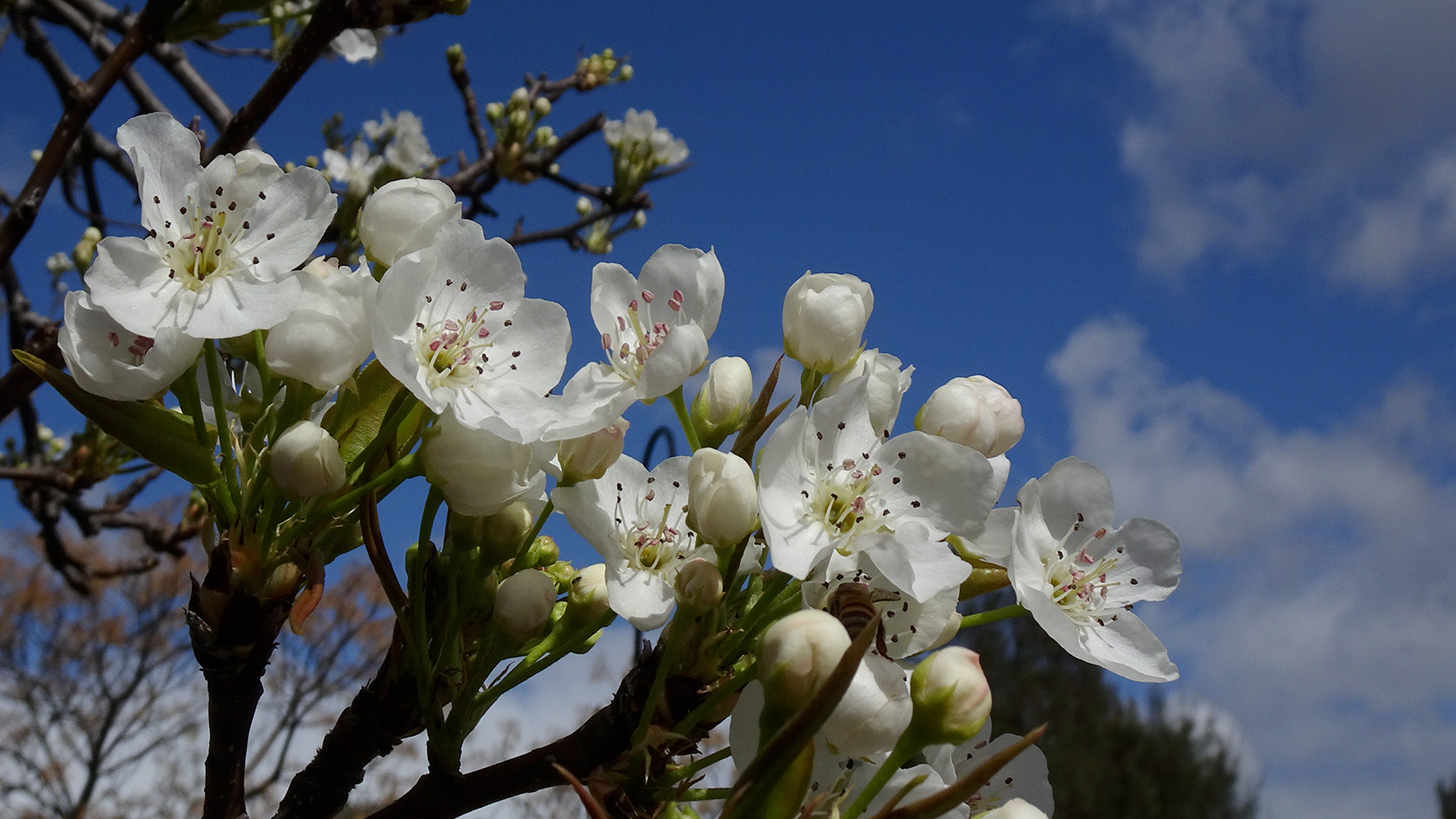
FFF560 - CALLERY PEAR

Pyrus calleryana, the Callery pear known in the USA as the Bradford Pear, is a species of pear native to China and Vietnam, in the family Rosaceae. It is a deciduous tree growing to 5 to 8 m tall, often with a conic to rounded crown. The leaves are oval, 4 to 8 cm long, glossy dark green above, and slightly paler below. 

The white, five-petaled flowers are about 2 to 2.5 cm in diameter. They are produced abundantly in early spring, before the leaves expand fully. The fruits of the Callery pear are small (less than one cm in diameter), and hard, almost woody, until softened by frost, after which they are readily taken by birds, which disperse the seeds in their droppings.

In summer, the foliage is dark green and very smooth, and in autumn the leaves commonly turn brilliant colours, ranging from yellow and orange to more commonly red, pink, purple, and bronze. Their dense clusters of white blossoms are conspicuous and very pretty in early spring, however their smell is commonly found unpleasant by many people (me included!). The smell is often described as 'fishy' and 'putrid'.

Join me for Floral Friday Fotos by linking your flower photos below, and please leave a comment once you have done so!
****If you take part in the meme, please show an active link back to this site on your own blog post!****


You are invited to the Inlinkz link party!

Click here to enter

Thursday, 8 September 2022

FFF559 - FOTHERGILLA

Fothergilla ‘Mount Airy’ is a hybrid Fothergilla cultivar that was discovered by plantsman Michael A. Dirr at the Mt. Airy Arboretum in Cincinnati, Ohio. This is a vigorous deciduous shrub that grows 1.5 m tall and is noted for its profuse spring flowering, excellent summer foliage, excellent Autumn colour and consistently upright habit.

Terminal, bottlebrush-like spikes (2-5 cm long) of tiny, fragrant, apetulous, white flowers bloom in mid- to late Spring after the foliage emerges. Flower colour comes from the dense clusters of showy stamens (white filaments and yellowish anthers). Flowers have a honey-scented fragrance. Leathery, ovate to obovate leaves (4-10 cm long) are dark green above and bluish-gray beneath.Foliage turns excellent shades of yellow, orange and red-purple in Autumn.

Genus name honours Dr. John Fothergill, 18th century English physician and early collector of American plants. ‘Mount Airy’ may be a cross between two southeastern U. S. natives, F. gardenii and F. major. It is taller than the former but shorter than the latter.

Join me for Floral Friday Fotos by linking your flower photos below, and please leave a comment once you have done so!
****If you take part in the meme, please show an active link back to this site on your own blog post!****

You are invited to the Inlinkz link party!

Click here to enter

Thursday, 1 September 2022

FFF558 - PURPLE-LEAF PLUM

Prunus cerasifera 'Atropurpurea' is a shrub to a small tree in the rose family that grows 15-25 feet tall and wide with a vase to a rounded shape. The reddish-purple leaves are the attraction to this plant along with the showy white to pink spring flowers, with a honey-like fragrance. The leaves maintain their colour most of the year. They are fairly short-lived and susceptible to insects and diseases. Twigs and fruit drop can be messy. Purpleleaf plum isn't picky about soil type or pH and is moderately drought tolerant once established. Leaf colour is best when grown in full sun.

The tree porduces 2 to 4 cm fleshy fruits, which are reddish-purple drupes. They are produced prolifically and are edible by wildlife and humans. They make excellent jam and can be pickled.

Join me for Floral Friday Fotos by linking your flower photos below, and please leave a comment once you have done so!
****If you take part in the meme, please show an active link back to this site on your own blog post!****

You are invited to the Inlinkz link party!

Click here to enter

Thursday, 18 August 2022

FFF556 - NARCISSUS

Narcissus is a genus of predominantly spring perennial plants in the Amaryllidaceae (amaryllis) family. Various common names including daffodil, daffadowndilly, narcissus, and jonquil are used to describe all or some members of the genus. Narcissus has conspicuous flowers with six petal-like tepals surmounted by a cup- or trumpet-shaped corona. The flowers are generally white or yellow (orange or pink in garden varieties), with either uniform or contrasting coloured tepals and corona. The hybrid illustrated here is "Tresamble".

Narcissus were well known in ancient civilisation, both medicinally and botanically, but formally described by Linnaeus' in his "Species Plantarum" (1753). The genus is generally considered to have about ten sections with approximately 50 species. The number of species has varied, depending on how they are classified, due to similarity between species and hybridisation. The genus arose some time in the Late Oligocene to Early Miocene epochs, in the Iberian peninsula and adjacent areas of southwest Europe.

The exact origin of the name Narcissus is unknown, but it is often linked to a Greek word for intoxicated (narcotic) and the myth of the youth of that name who fell in love with his own reflection. The English word 'daffodil' appears to be derived from "asphodel", with which it was commonly compared. The species are native to meadows and woods in southwest Europe and North Africa with a centre of diversity in the Western Mediterranean, particularly the Iberian peninsula. Both wild and cultivated plants have naturalised widely, and were introduced into the Far East prior to the tenth century.

Narcissi tend to be long-lived bulbs, which propagate by division, but are also insect-pollinated. Known pests, diseases and disorders include viruses, fungi, the larvae of flies, mites and nematodes. Some Narcissus species have become extinct, while others are threatened by increasing urbanisation and tourism.

Join me for Floral Friday Fotos by linking your flower photos below, and please leave a comment once you have done so!
 ****If you take part in the meme, please show an active link back to this site on your own blog post!****


You are invited to the Inlinkz link party!

Click here to enter

Wednesday, 13 October 2021

FFF514 - MR LINCOLN ROSE

Rosa "Mr Lincoln" was bred by Swim & Weeks, USA in 1964.  This is a very tall growing rose to 1.8 metres should be planted at the back of the rose bed where it will shine over and above all the roses and the breath-taking fragrance will still be enjoyed.

Mr. Lincoln has retained its popularity over the years because it is just so reliable a performer with very tough, leathery foliage, especially loving the heat. As with most dark red roses, Mr. Lincoln has very sharp thorns and produces huge, thick watershoots which should be pruned with loppers rather than secateurs. 

Join me for Floral Friday Fotos by linking your flower photos below, and please leave a comment once you have done so.
If you take part in the meme, please show an active link back to this site on your own blog post!


You are invited to the Inlinkz link party!

Click here to enter

Thursday, 9 September 2021

FFF509 - VIBURNUM

Viburnum tinus (Laurustinus, laurustinus viburnum, or laurestine) is a species of flowering plant in the family Adoxaceae, native to the Mediterranean area of Europe and North Africa. Laurus signifies the leaves' similarities to bay laurel. It is a shrub (rarely a small tree) reaching 2–7 m tall and 3 m broad, with a dense, rounded crown. The leaves are evergreen, persisting 2–3 years, ovate to elliptic, borne in opposite pairs, 4–10 cm long and 2–4 cm broad, with an entire margin.

The flowers are small, white or light pink, produced from reddish-pink buds in dense cymes 5–10 cm diameter in the winter. The fragrant flowers are bisexual and pentamerous. The flowering period is from October to June (Northern Hemisphere). Pollination is by insects. The fruit is a dark blue-black drupe 5–7 mm long.

V. tinus has medicinal properties. The active ingredients are viburnin (a substance or more probably a mixture of compounds) and tannins. Tannins can cause stomach upset. The leaves when infused have antipyretic properties. The fruits have been used as purgatives against constipation. The tincture has been used lately in herbal medicine as a remedy for depression. The plant also contains iridoid glucosides.

Join me for Floral Friday Fotos by linking your flower photos below, and please leave a comment once you have done so!
****If you take part in the meme, please show an active link back to this site on your own blog post!****

You are invited to the Inlinkz link party!

Click here to enter