The rules for posting are simple!

1. Every Friday post a photo that includes one or more flowers.
2. Please only post photos you have authority to use.
3. Include a link to this blog in your post - http://floralfridayfoto.blogspot.com/
4. Leave the link to your FloralFridayFoto post below on inlinkz.
5. Visit other blogs listed ... comment & enjoy!

When to Post:
inlinkz will be available every Thursday and will remain open until the next Wednesday.

Thursday, 15 June 2023

FFF599 - RUEFUL BEE

Ruta graveolens, commonly known as rue, common rue or herb-of-grace, is a species of Ruta grown as an ornamental plant and herb. It is native to the Balkan Peninsula. It is grown throughout the world in gardens, especially for its bluish leaves, and sometimes for its tolerance of hot and dry soil conditions. It is also cultivated as a culinary herb, and to a lesser extent as an insect repellent and incense.

Join me for Floral Friday Fotos by linking your flower photos below, and please leave a comment once you have done so.
****If you take part in the meme, please show an active link back to this site on your own blog post!***


You are invited to the Inlinkz link party!

Click here to enter

Thursday, 8 June 2023

FFF598 - OSTEOSPERMUM

Osteospermum is a genus of flowering plants belonging to the Calenduleae, one of the smaller tribes of the sunflower/daisy family Asteraceae. The common name is African daisy or Cape daisy.

Osteospermum used to belong to the genus Dimorphotheca, but only the annual species remain in that genus now; the perennials have been placed in the genus Osteospermum. Osteospermum is also closely related to the small genus Chrysanthemoides, and the resemblance is seen in species such as C. incana and C. monilifera.

Join me for Floral Friday Fotos by linking your flower photos below, and please leave a comment once you have done so.
****If you take part in the meme, please show an active link back to this site on your own blog post!***


You are invited to the Inlinkz link party!

Click here to enter

Thursday, 1 June 2023

FFF597 - ART EXHIBITION

My solo art exhibition "Seasons in the Garden" opened today in the Northcote Public Library Exhibition Space, "LibArt Gallery", at 32-38 Separation St, Northcote 3070 Victoria, on June 1st, 2023. Entry is free and the exhibition is open until June 30th.

There are twenty one works on display and the theme of seasonal flora in an urban garden runs through the exhibited paintings. Feel free to wander in and have a look if you are in Northcote or surrounds.

Hours at the Library: Mon–Fri 10am–8pm; Sat 10am–4pm; Sun 1–5pm 

Join me for Floral Friday Fotos by linking your flower photos below, and please leave a comment once you have done so.
****If you take part in the meme, please show an active link back to this site on your own blog post!***

You are invited to the Inlinkz link party!

Click here to enter

Thursday, 25 May 2023

FFF596 - PETUNIA

Petunia "Raspberry Blast" is a hybrid, with pink blooms edged in deep cerise. Its trailing habit and low maintenance makes it a winner for both baskets and beds. It grew quite happily in our hanging baskets last Summer and it always got a comment from visitors.

Join me for Floral Friday Fotos by linking your flower photos below, and please leave a comment once you have done so.
****If you take part in the meme, please show an active link back to this site on your own blog post!***
  

You are invited to the Inlinkz link party!

Click here to enter

Thursday, 18 May 2023

FFF595 - WHITE CROWN

Protea cynaroides "White Crown" is a small evergreen shrub growing approximately 45cm x 45cm. Its creamy white flowers are highlighted amid lush green foliage. Very versatile, this shrub is well suited container planting, rockeries and large scale landscape projects.
The genus Protea was named after the Greek god Proteus, who could change his shape and appearance at will.
This hybrid Protea flowers from summer through to winter. The flowers can be cut and used for floral arrangements. As with all Proteas, they are very drought hardy plant once established. They prefer full sun, but can tolerate partial shade and mild frost. Fertilize in spring with native slow release fertilizer or compost before mulching.

Join me for Floral Friday Fotos by linking your flower photos below, and please leave a comment once you have done so.
****If you take part in the meme, please show an active link back to this site on your own blog post!***


You are invited to the Inlinkz link party!

Click here to enter

Thursday, 11 May 2023

FFF594 - CLERODENDRUM

Clerodendrum is a genus of flowering plants formerly placed in the family Verbenaceae, but now considered to belong to the Lamiaceae (mint) family. Its common names include glorybower, bagflower and bleeding-heart. It is currently classified in the subfamily Ajugoideae, being one of several genera transferred from Verbenaceae to Lamiaceae in the 1990s, based on phylogenetic analysis of morphological and molecular data.
Estimates of the number of species in Clerodendrum vary widely, from about 150 to about 450. This is partly because about 30 species have been transferred to Rotheca, about 30 more to Volkameria, and 1 to Ovieda.
Illustrated here is the 'Bleeding-heart-vine' (Clerodendrum thomsoniae).

Join me for Floral Friday Fotos by linking your flower photos below, and please leave a comment once you have done so.
****If you take part in the meme, please show an active link back to this site on your own blog post!***


You are invited to the Inlinkz link party!

Click here to enter

Thursday, 4 May 2023

FFF593 - HAEMANTHUS

Haemanthus coccineus (commonly known as the Blood Flower or Paintbrush Lily), is a bulbous geophyte in the genus Haemanthus, native to Southern Africa. The generic name Haemanthus is derived from the Greek words haima for "blood" and anthos for "flower"; coccineus is the Latin word for red or scarlet. In the Afrikaans language it is known as Bergajuin, Bloedblom, and many other vernacular names.

The Blood Lily is native throughout the winter rainfall region in Southern Africa - from the southern parts of Namibia, to South Africa in the Cape Peninsula, to the Keiskamma River in the Eastern Cape. It is an adaptable species, growing in a wide range of soils derived from sandstones, quartzites, granites, shales and limestones. It will survive annual rainfall ranging from 100–1,100 millimetres.

The large (up to 10 cm diameter) flowerheads of Haemanthus coccineus emerge between February and April in the Southern Hemisphere, with scarlet spathe valves on them like bright shaving brushes, making it a striking plant. The flowers are soon followed by translucent, fleshy berries. There are usually two very large leaves per bulb, and occasionally three, these leaves appearing only after flowering has occurred.

We have it growing in our garden quite happily and it always attracts a lot of attention when it is in bloom.

Join me for Floral Friday Fotos by linking your flower photos below, and please leave a comment once you have done so.
****If you take part in the meme, please show an active link back to this site on your own blog post!***


You are invited to the Inlinkz link party!

Click here to enter

Thursday, 27 April 2023

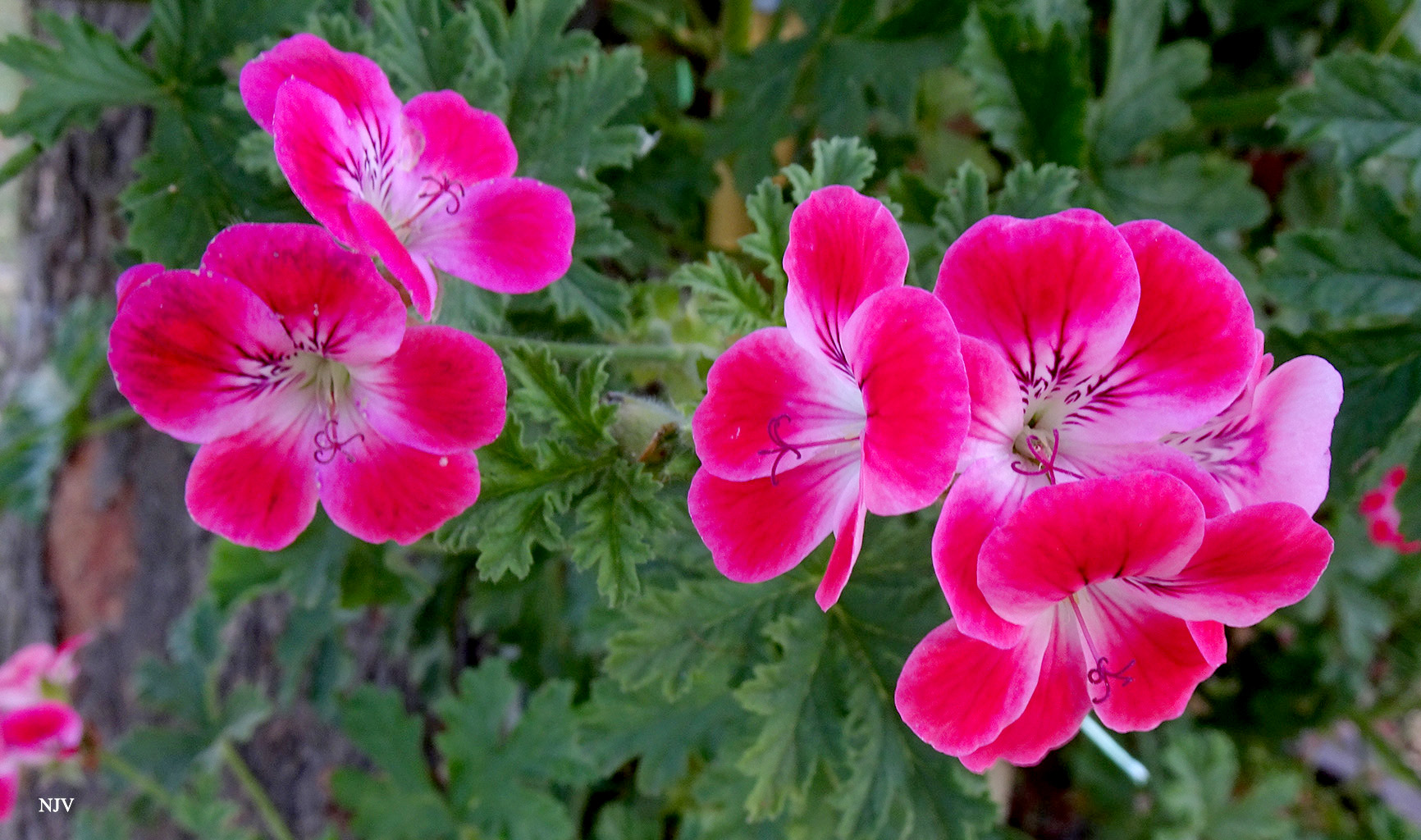
FFF592 - PELARGONIUM

Pelargonium is a genus of flowering plants which includes about 200 species of perennials, succulents, and shrubs, commonly known as geraniums (in the United States also storksbills). Confusingly, Geranium is the correct botanical name of a separate genus of related plants often called cranesbills or hardy geraniums. Both genera belong to the family Geraniaceae.

Linnaeus originally included all the species in one genus, Geranium, but they were later separated into two genera by Charles L’Héritier in 1789. Pelargonium species are evergreen perennials indigenous to Southern Africa, and are drought and heat tolerant, but can tolerate only minor frosts. They are extremely popular garden plants, grown as bedding plants in temperate regions.

Regal (Royal, French) varieties or Pelargonium × domesticum are mainly derived from P. cucullatum and P. grandiflorum. They have woody stems, wrinkled leaves and pointed lobes, and are mainly grown in greenhouses.

Join me for Floral Friday Fotos by linking your flower photos below, and please leave a comment once you have done so.
****If you take part in the meme, please show an active link back to this site on your own blog post!***

You are invited to the Inlinkz link party!

Click here to enter

Thursday, 20 April 2023

FFF591 - COREOPSIS

Coreopsis is a genus of flowering plants in the family Asteraceae. Common names include calliopsis and tickseed, a name shared with various other plants.

These plants range from 46–120 centimetres in height. The flowers are usually yellow with a toothed tip, but may also be yellow-and-red bicolor. They have showy flower heads with involucral bracts in two distinct series of eight each, the outer being commonly connate at the base.

The flat fruits are small and dry and look like insects. There are 75–80 species of Coreopsis, all of which are native to North, Central, and South America. The name Coreopsis is derived from the Greek words κόρις (koris), meaning "bedbug", and ὄψις (opsis), meaning "view", referring to the shape of the achene.

Join me for Floral Friday Fotos by linking your flower photos below, and please leave a comment once you have done so.
****If you take part in the meme, please show an active link back to this site on your own blog post!***


You are invited to the Inlinkz link party!

Click here to enter

Thursday, 13 April 2023

FFF590 - SAINTPAULIA

Saintpaulia, commonly known as African violet, is a genus of 6–20 species of herbaceous perennial flowering plants in the family Gesneriaceae, native to Tanzania and adjacent southeastern Kenya in eastern tropical Africa. 
Typically the African violet is a common household indoor plant but can also be an outdoor plant. Several of the species and subspecies are endangered, and many more are threatened, due to their native cloud forest habitats being cleared for agriculture.
The conservation status of Saintpaulia ionantha has been classed as near-threatened. Saintpaulias, which grow from 6–15 cm tall, can be anywhere from 6–30 cm wide. The leaves are rounded to oval, 2.5–8.5 cm long with a 2–10 cm petiole, finely hairy, and have a fleshy texture.
The flowers are 2–3 cm in diameter, with a five-lobed velvety corolla ("petals"), and grow in clusters of 3–10 or more on slender stalks called peduncles. Wild species can have violet, purple, pale blue, or white flowers.

Join me for Floral Friday Fotos by linking your flower photos below, and please leave a comment once you have done so.
****If you take part in the meme, please show an active link back to this site on your own blog post!****


You are invited to the Inlinkz link party!

Click here to enter