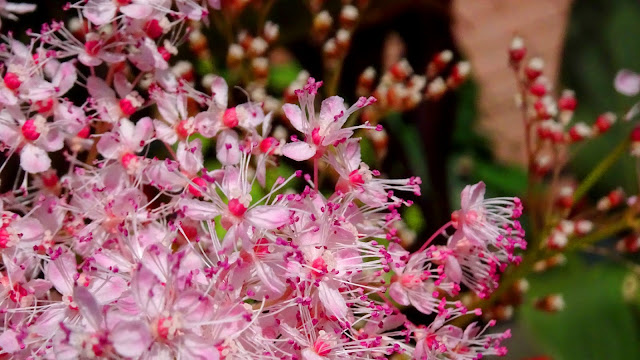
Bergenia (elephant-eared saxifrage, elephant's ears) is a genus of ten species of flowering plants in the family Saxifragaceae, native to central Asia, from Afghanistan to China and the Himalayan region. They are clump-forming, rhizomatous, evergreen perennials with a spirally arranged rosette of leaves 6–35 cm long and 4–15 cm broad, and pink flowers produced in a cyme.
The leaves are large, leathery, ovate or cordate, and often have wavy or saw-toothed edges. For most of the year, the leaves have a glossy green colour, but in cooler climates, they turn red or bronze in the Autumn. The flowers grow on a stem similar in colour to a rhubarb stalk and most varieties have cone-shaped flowers in varying shades of pink. These can range from almost white to ruby red and purple.
The common names for Bergenia are pigsqueak (due to the sound produced when two leaves are rubbed together), elephant's ears (due to the shape of the leaves) and large rockfoil. Bergenia is closely related to Mukdenia, Oresitrophe, Astilboides and Rodgersia. The creator of the taxonomic genus name, Conrad Moench, honoured the German botanist and physician Karl August von Bergen by coining the name Bergenia in 1794.
Join me for Floral Friday Fotos by linking your flower photos below, and please leave a comment once you have done so.
**If you take part in the meme, please show an active link back to this site on your own blog post!***
Add your own link to the Linky list below and say hello in a comment. Please visit other participants in the meme. Thank you for your loyalty and perseverance in linking up, it is appreciated!