The rules for posting are simple!

1. Every Friday post a photo that includes one or more flowers.
2. Please only post photos you have authority to use.
3. Include a link to this blog in your post - http://floralfridayfoto.blogspot.com/
4. Leave the link to your FloralFridayFoto post below on inlinkz.
5. Visit other blogs listed ... comment & enjoy!

When to Post:
inlinkz will be available every Thursday and will remain open until the next Wednesday.

Thursday, 6 January 2022

FFF526 - COMMON EVERLASTING

Chrysocephalum apiculatum of the Asteraceae family is often referred to as ‘yellow buttons’ or ‘common everlasting’.  A tough plant from areas such as the Yorke Peninsula and other areas, this is a low growing evergreen perennial. As with many plants that grow over a wide areas, a number of different forms are available, the main difference seeming to be in height.

Silvery grey green foliage buttery yellow flowers that are tightly held on tallish stems. Chrysocephalum grow over a large part of Australia and good drainage would seem to be important. Chrysocephalum apiculatum grows to about 0.5m, has a low water requirement and seems to tolerate frost.

It is a fast growing plant that will spread to around 1m, the long lasting flowers make it a welcome addition to the garden border. It does grow well in near coastal conditions and is very low care.

Join me for Floral Friday Fotos by linking your flower photos below, and please leave a comment once you have done so.
If you take part in the meme, please show an active link back to this site on your own blog post!


You are invited to the Inlinkz link party!

Click here to enter

Thursday, 30 December 2021

FFF525 - CURRY TREE

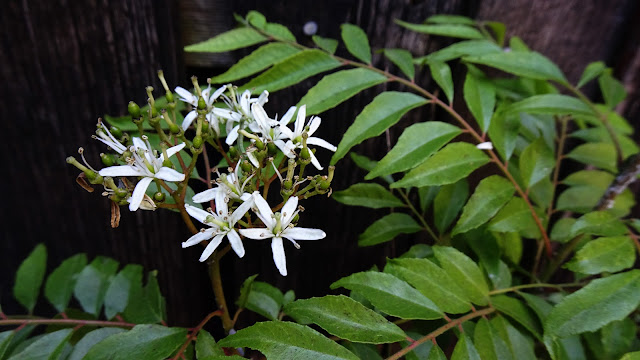
The curry tree, Murraya koenigii or Bergera koenigii, is a tropical to sub-tropical tree in the family Rutaceae (the rue family, which includes rue, citrus, and satinwood), and is native to Asia. The plant is also sometimes called sweet neem, though M. koenigii is in a different family to neem, Azadirachta indica, which is in the related family Meliaceae. Its leaves, known as curry leaves, are used in many dishes in the Indian subcontinent.

Join me for Floral Friday Fotos by linking your flower photos below, and please leave a comment once you have done so.
If you take part in the meme, please show an active link back to this site on your own blog post!


You are invited to the Inlinkz link party!

Click here to enter

Thursday, 23 December 2021

FFF524 - CHRISTMAS LILY

Lilium candidum, the Madonna lily (known as the Christmas Lily in Australia as it flowers around Christmas), is a plant in the true lily family, the Liliaceae. It is native to Balkans and the Middle East, and naturalised in other parts of Europe (France, Italy, Ukraine, etc.) as well as in North Africa, the Canary Islands, Mexico, and other places.

It forms bulbs at ground level, and unlike other lilies, has a basal rosette of leaves through the winter, which die back in summer. A leafy flower stem, typically up to 1.2 metres high, sometimes up to 2 metres high, emerges in late spring and bears sweetly and headily fragrant flowers in summer. Flowers are white, flushed yellow at the base.

It has long been cultivated, but is susceptible to virus diseases of lilies, and to Botrytis fungus. One possible way to avoid problems with viruses is to grow plants raised from seed. We have these beautiful lilies growing in our garden and they are quite healthy and flowering prolifically.

Join me for Floral Friday Fotos by linking your flower photos below, and please leave a comment once you have done so. If you take part in the meme, please show an active link back to this site on your own blog post!


You are invited to the Inlinkz link party!

Click here to enter

Thursday, 16 December 2021

FFF523 - KNAUTIA

Knautia is a genus in the family Caprifoliaceae. The common names of these flowers are a variant of "widow flower." Others are given the name "Scabious," although this word belongs to a related genus (Scabiosa). The name Knautia comes from the 17th-century German botanists, Drs. Christoph and Christian Knaut.

It is a perennial plant that grows between 25 and 100 cm. It prefers grassy places and dry soils, avoiding heavy soils, and flowers between July and September. The flowered head is flatter than similar species Devils-bit scabious and Small scabious. 

There are 4 stamens in each flower, and 1 notched long stigma. The fruit is nut like, cylindrical and hairy, 5–6 mm in size. It has a tap root. The stem has long stiff hairs angled downwards. There are no stipules. The leaves form a basal rosette, are paired on the stem, the lowest typically 300 mm long, spear shaped, whereas the upper are smaller.

Join me for Floral Friday Fotos by linking your flower photos below, and please leave a comment once you have done so. If you take part in the meme, please show an active link back to this site on your own blog post!


You are invited to the Inlinkz link party!

Click here to enter

Thursday, 9 December 2021

FFF522 - PONTEDERIA

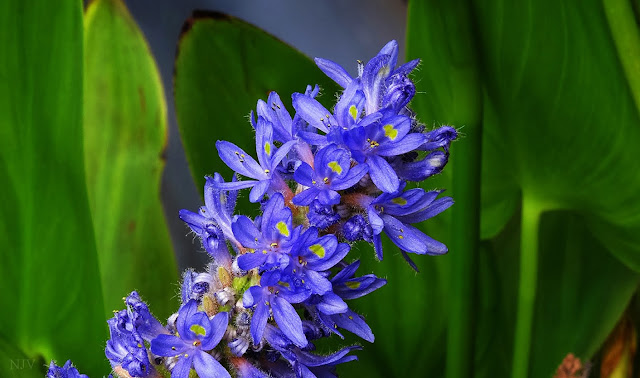
Pontederia cordata, common name pickerelweed (USA) or pickerel weed (UK), is a monocotyledonous aquatic plant native to the American continent. It grows in a variety of wetlands, including pond and lake margins across an extremely large range from eastern Canada south to Argentina. A few examples include northern rivers, the Everglades and Louisiana. The species grows as an emergent plant, that is, in flooded conditions, so the plant is generally dependent upon aerenchyma in the stem to carry oxygen into the roots. Its metabolism, is, however, also tolerant of low soil oxygen.

It is often found in areas where water levels fluctuate naturally, with spring flooding and later summer emergence. Apart from flooding, the species is also influenced by soil fertility, tending to grow in the more fertile bays of large lakes, for example. Like many aquatic plants, it is negatively affected by salinity and grazing. It is also negatively affected by competition from other wetland plants. Like many wetland plants, it can survive unfavourable conditions as buried seeds in the soil.

The plant flowers in late summer. The purple flowers have yellow markings which may assist in attracting bees for pollination. One bee species known to pollinate the flowers is Dufourea (Halictoides) novaeangliae. Once the plant begins to produce seeds, the stem supporting the inflorescence bends to submerse the fruits and seeds. Seeds are dormant at the time of dispersal and will not germinate without stratification for 6-8 weeks.

Join me for Floral Friday Fotos by linking your flower photos below, and please leave a comment once you have done so.
If you take part in the meme, please show an active link back to this site on your own blog post!

You are invited to the Inlinkz link party!

Click here to enter

Thursday, 2 December 2021

FFF521 - SPOTTED SUN ORCHID

Thelymitra ixioides, known as the Spotted Sun Orchid is a common plant in eastern and southern Australia, it is also found in New Zealand and New Caledonia. Leaves are thin or lanceolate, up to 20 cm long. A small plant of the Orchidaceae family, it has spotted flowers, forming from August to January. They are usually blue, but sometimes violet. It grows in eucalyptus woodland or heathland.

Thelymitra is derived from the Greek thely, female and mitra, a headdress, referring to the appearance of the plumed column (the fused stamens, styles and stigma). The specific name ixioides means similar to the genus Ixia. It is known as the "sun orchid" because the flowers of most species only open fully on warm, sunny days. There are about 80 species of terrestrial orchids in the genus Thelymitra.

As T. ixioides has fairly specialised cultural needs (like most terrestrial orchids) it is cultivated mainly by orchid enthusiasts. Generally the plants are grown in pots in a freely draining, sandy mix. They require good air circulation in a protected position of about 50% sun during the growing period from autumn to spring. During this growing period the plants must not be allowed to dry out. After the leaves have turned brown in late spring to early summer the pots are allowed to dry out completely. Repotting of tubers can be carried out in summer. This orchid is not considered to be at risk in the wild.

Join me for Floral Friday Fotos by linking your flower photos below, and please leave a comment once you have done so. If you take part in the meme, please show an active link back to this site on your own blog post!

Join me for Floral Friday Fotos by linking your flower photos below, and please leave a comment once you have done so.

If you take part in the meme, please show an active link back to this site on your own blog post!


You are invited to the Inlinkz link party!

Click here to enter

Thursday, 25 November 2021

FFF520 - SALVIA

Salvia sinaloensis ‘Aztec Blue’ in the family Lamiaceae is a native of Mexico and originates in the country's province of Sinaloa. It is a delightful little plant which will grow and spread slowly via underground runners to form an attractive ground cover which is non-invasive.

The exceptional flower colour of this variety of salvia needs to be seen to be believed. The intense and vibrant blue is as close to a true blue that you will ever find in the plant kingdom. Its charm does not end there, however, as the foliage too offers ornamental value to the garden designer. As young leaves emerge they a delightful plum colour slowly changing to an olive green as they age but always retaining a bronze tinge providing the plant is in full sun. When planted in light shade greener foliage results.

For best results, flowering and foliage colour, choose a sunny site in free draining soil. A herbaceous perennial in cooler climates but generally foliage will remain year round and can be trimmed by half during winter months. An application of slow release fertiliser in spring is recommended. Removing spent flower stems will encourage further flowering.

Join me for Floral Friday Fotos by linking your flower photos below, and please leave a comment once you have done so.
If you take part in the meme, please show an active link back to this site on your own blog post!


You are invited to the Inlinkz link party!

Click here to enter

Thursday, 18 November 2021

FFF519 - JACOBINIA

 A member of the Acanthaceae family, the Brazilian plume flower or jacobinia (Justicia carnea) is a shade-loving, soft-wooded shrub (ht 1.5m) with large, lush leaves. Thick plumes of white, pale pink or deep pink tubular flowers appear in regular flushes from early summer to late autumn. A form with dark purplish underleaves is known as 'Radiant' - perhaps more correctly should be called 'Huntington Form'. 

Justicia carnea needs hard pruning in late winter, and regular dead-heading during summer will help to promote new blooms. It will also flourish in sunny spots but is useful for shaded sites, as are so many of the Acanthaceae family, which do so well in temperate climates. Whilst it will stand neglect, it responds well to feeding and watering. It is easily propagated from cuttings. It is a good companion to hydrangeas, Plectranthus species, ferns and camellias. The white form looks pretty with silver-leaved companions, such as Plectranthus argentatus and Pilea cadierei.

Join me for Floral Friday Fotos by linking your flower photos below, and please leave a comment once you have done so. If you take part in the meme, please show an active link back to this site on your own blog post!


You are invited to the Inlinkz link party!

Click here to enter

Thursday, 11 November 2021

FFF518 - SCHLUMBERGERA

Schlumbergera is a small genus of cacti with six species found in the coastal mountains of south-eastern Brazil. Plants grow on trees or rocks in habitats which are generally shady with high humidity and can be quite different in appearance from their desert-dwelling cousins.

Most species of Schlumbergera have stems which resemble leaf-like pads joined one to the other and flowers which appear from areoles at the joints and tips of the stems. Two species have cylindrical stems more similar to other cacti. In Brazil, the genus is referred to as Flor de Maio (May flower), reflecting the period in which they flower in the Southern Hemisphere. It is also called Easter cactus.

Join me for Floral Friday Fotos by linking your flower photos below, and please leave a comment once you have done so. If you take part in the meme, please show an active link back to this site on your own blog post!


You are invited to the Inlinkz link party!

Click here to enter

Thursday, 4 November 2021

FFF517 - ISOPOGON

Isopogon formosus or Rose Cone Flower is a shrub in the Proteaceae family that is endemic to areas near Albany and Esperance in Western Australia. In occurs naturally in heathland and woodland areas. It has an erect or bushy form and is usually between 1.5 and 2 metres high. The pink flowers appear from mid winter to early summer. Rounded "drumsticks" containing the seeds appear later, formed from the old flower parts. The plant's leaves are divided, narrow, terete and about 5 cm long.

Isopogon formosus prefers full sun to partial shade in a well-drained sandy or gravelly soil. In the Australian National Botanic Gardens (ANBG) in Canberra they use a special mix of 2:1 sand and granite. It will tolerate light or moderate frosts but will not tolerate heavy frosts or extended periods of dryness. It can be propagated by either seed or cutting. The ANBG have had more success with cuttings than seed. When taking cuttings use older material, not that from the soft tips. A rooting hormone such as IBA should be used to promote root growth.

Isopogon formosus responds well to light pruning which improves the shape. Tip pruning from an early stage promotes lateral growth, however it must not be over-pruned. It does not suffer from any particular pest but is susceptible to the root rot fungus Phytophthora cinnamoni. You should also only use a slow release fertiliser or one that is suitable for Australian natives as this Isopogon is particularly sensitive to soluble phosphorus.

It is difficult to cultivate this plant in the eastern states, as it will not tolerate humidity and is less hardy than some of the naturally occurring eastern species. A possible alternate way for it to be grown is to grow it in a pot as the particular conditions it requires can be satisfied readily and be more easily monitored. It is well worth attempting to grow, as it is a spectacular plant that can be used as a feature in the garden all year round.

Join me for Floral Friday Fotos by linking your flower photos below, and please leave a comment once you have done so.
If you take part in the meme, please show an active link back to this site on your own blog post!


You are invited to the Inlinkz link party!

Click here to enter