The rules for posting are simple!

1. Every Friday post a photo that includes one or more flowers.
2. Please only post photos you have authority to use.
3. Include a link to this blog in your post - http://floralfridayfoto.blogspot.com/
4. Leave the link to your FloralFridayFoto post below on inlinkz.
5. Visit other blogs listed ... comment & enjoy!

When to Post:
inlinkz will be available every Thursday and will remain open until the next Wednesday.

Thursday, 25 August 2022

FFF557 - WINTER JASMINE

Jasminum nudiflorum, the winter jasmine, is a slender, deciduous shrub native to China (Gansu, Shaanxi, Sichuan, Xizang (Tibet), Yunnan). The flower's blossoming peaks right after winter, which is why it is also named Yingchun (迎春) in Chinese, which means "the flower that welcomes Spring". It is widely cultivated as an ornamental and is reportedly naturalized in France and in scattered locations in the United States (Texas, Oklahoma, Georgia, Tennessee, Maryland and New Jersey).

Jasminum nudiflorum is valued by gardeners as one of the few plants that are in flower during the winter months. It is frequently trained against a wall to provide extra warmth and shelter, but also lends itself to groundcover. It tolerates hard pruning and should be pruned in spring immediately after flowering; regular pruning will help to prevent bare patches. It can also be grown as a bonsai and is very tolerant of the wiring methods. It likes full sun or partial shade and is hardy. It has gained the Royal Horticultural Society's Award of Garden Merit. It can be propagated using the layering technique.

Join me for Floral Friday Fotos by linking your flower photos below, and please leave a comment once you have done so!
****If you take part in the meme, please show an active link back to this site on your own blog post!****


You are invited to the Inlinkz link party!

Click here to enter

Thursday, 18 August 2022

FFF556 - NARCISSUS

Narcissus is a genus of predominantly spring perennial plants in the Amaryllidaceae (amaryllis) family. Various common names including daffodil, daffadowndilly, narcissus, and jonquil are used to describe all or some members of the genus. Narcissus has conspicuous flowers with six petal-like tepals surmounted by a cup- or trumpet-shaped corona. The flowers are generally white or yellow (orange or pink in garden varieties), with either uniform or contrasting coloured tepals and corona. The hybrid illustrated here is "Tresamble".

Narcissus were well known in ancient civilisation, both medicinally and botanically, but formally described by Linnaeus' in his "Species Plantarum" (1753). The genus is generally considered to have about ten sections with approximately 50 species. The number of species has varied, depending on how they are classified, due to similarity between species and hybridisation. The genus arose some time in the Late Oligocene to Early Miocene epochs, in the Iberian peninsula and adjacent areas of southwest Europe.

The exact origin of the name Narcissus is unknown, but it is often linked to a Greek word for intoxicated (narcotic) and the myth of the youth of that name who fell in love with his own reflection. The English word 'daffodil' appears to be derived from "asphodel", with which it was commonly compared. The species are native to meadows and woods in southwest Europe and North Africa with a centre of diversity in the Western Mediterranean, particularly the Iberian peninsula. Both wild and cultivated plants have naturalised widely, and were introduced into the Far East prior to the tenth century.

Narcissi tend to be long-lived bulbs, which propagate by division, but are also insect-pollinated. Known pests, diseases and disorders include viruses, fungi, the larvae of flies, mites and nematodes. Some Narcissus species have become extinct, while others are threatened by increasing urbanisation and tourism.

Join me for Floral Friday Fotos by linking your flower photos below, and please leave a comment once you have done so!
 ****If you take part in the meme, please show an active link back to this site on your own blog post!****


You are invited to the Inlinkz link party!

Click here to enter

Thursday, 11 August 2022

FFF555 - SCABIOUS

Scabiosa is a genus in the teasel Family Dipsacaceae of flowering plants. Many of the species in this genus have common names that include the word scabious; however some plants commonly known as scabious are currently classified in related genera such as Knautia and Succisa; at least some of these were formerly placed in Scabiosa. Another common name for members of this genus is pincushion flowers.

Members of this genus are native to Europe and Asia. Some species of Scabiosa, notably small scabious (S. columbaria) and Mediterranean sweet scabious (S. atropurpurea) have been developed into cultivars for gardeners. Illustrated here is the Scabiosa columbaria cultivar 'Pink Mist'.

Scabiosa plants have many small flowers of soft lavender blue, lilac or creamy white colour borne in a single head on a tall stalk. Scabious flowers are nectar rich and attract a variety of insects including moths and butterflies such as the Six-spot Burnet. Scabiosa species are also used as food plants by the larvae of some Lepidoptera species including Grey Pug.

Join me for Floral Friday Fotos by linking your flower photos below, and please leave a comment once you have done so.


You are invited to the Inlinkz link party!

Click here to enter

Thursday, 4 August 2022

FFF554 - MOUNTAIN MARIGOLD

Tagetes lemmonii, or Lemmon's marigold, is a North American species of shrubby marigold, in the family Asteraceae. Other English names for this plant include Copper Canyon Daisy, Mountain Marigold, and Mexican Marigold. It is native to the states of Sonora and Sinaloa in northwestern Mexico as well as southern Arizona in the United States.

Mountain marigold is a shrub sometimes reaching as much as 240 cm tall. Leaves are up to 12 cm long, pinnately compound into 3-5 leaflets, each leaflet narrowly lance-shaped with teeth along the edge. The plant produces many small flower heads in a flat-topped array, each head with 3-8 ray florets and 12-30 disc florets. It grows in woodlands, cliffs, and moist sites.

Tagetes lemmonii blooms from fall into spring and can sometimes be blooming for up to 10 months. The foliage is fragrant (or unpleasantly pungent to some people) when disturbed. The species is very drought tolerant in a Mediterranean climate and much used in California gardens where it tolerates light frosts without damage. It is common in Melbourne, with many gardens having good displays of flowers even in Winter.

Leaves and flowers can be dried and added to potpourri and scented sachets, for their scent and colour, but also for their pest repellent qualities.

Join me for Floral Friday Fotos by linking your flower photos below, and please leave a comment once you have done so.


You are invited to the Inlinkz link party!

Click here to enter

Thursday, 28 July 2022

FFF553 - GERBERAS

Gerbera L. is a genus of ornamental plants from the sunflower family (Asteraceae). It was named in honour of the German botanist and naturalist Traugott Gerber († 1743) who travelled extensively in Russia and was a friend of Carolus Linnaeus. It has approximately 30 species in the wild, extending to South America, Africa and tropical Asia. Gerbera is also commonly known as the African Daisy.

Gerbera species bear a large capitulum with striking, two-lipped ray florets in yellow, orange, white, pink or red colours. The capitulum, which has the appearance of a single flower, is actually composed of hundreds of individual flowers. The morphology of the flowers varies depending on their position in the capitulum. The flower heads can be as small as 7 cm (Gerbera mini 'Harley') in diameter or up to 12 cm (Gerbera ‘Golden Serena’).

Gerbera is very popular and widely used as a decorative garden plant or as cut flowers. The domesticated cultivars are mostly a result of a cross between Gerbera jamesonii and another South African species Gerbera viridifolia. The cross is known as Gerbera hybrida. Thousands of cultivars exist. They vary greatly in shape and size. Colours include white, yellow, orange, red, and pink. The centre of the flower is sometimes black. Often the same flower can have petals of several different colours. 

Gerbera is also important commercially. It is the fifth most used cut flower in the world (after rose, carnation, chrysanthemum, and tulip). It is also used as a model organism in studying flower formation. Gerbera contains naturally occurring coumarin derivatives. Gerbera is a tender perennial plant. It is attractive to bees, butterflies and/or birds, but resistant to deer. The soil should be kept moist but not soaked.

Join me for Floral Friday Fotos by linking your flower photos below, and please leave a comment once you have done so.


You are invited to the Inlinkz link party!

Click here to enter

Thursday, 21 July 2022

FFF552 - RED GERANIUM

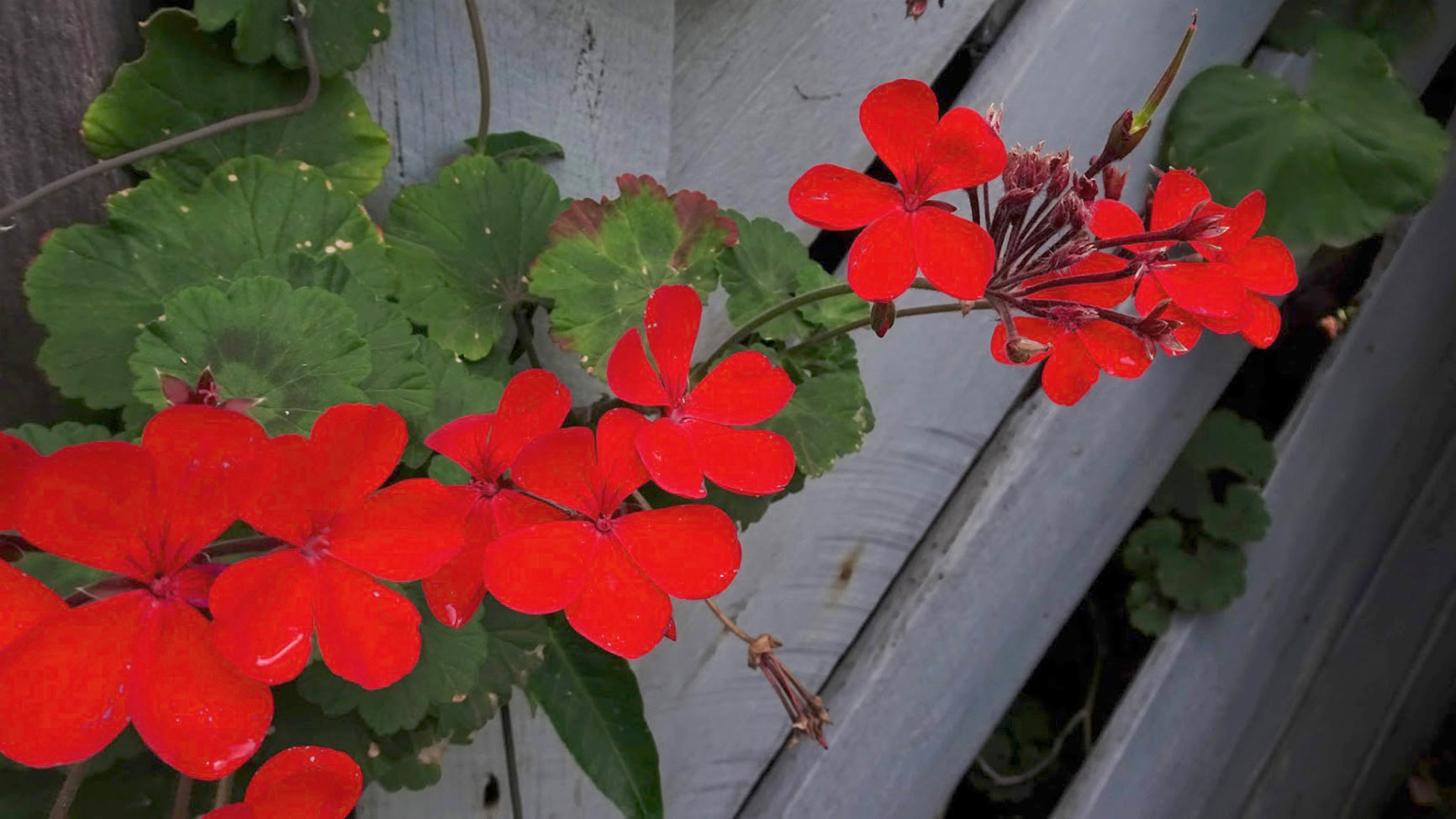
Pelargonium x garden is also known as the common geranium, zonal geranium or bedding geranium and is a common species in the Geraniaceae Family. This species of geranium is most commonly used as an ornamental plant. Hybrids include the usual nursery "seed-grown" and the "cutting grown", which can easily be grown at home by cutting and planting side branches.

Join me for Floral Friday Fotos by linking your flower photos below, and please leave a comment once you have done so.

You are invited to the Inlinkz link party!

Click here to enter

Thursday, 14 July 2022

FFF552 - CAMELLIA

Camellia is a genus of flowering plants in the family Theaceae. They are found in eastern and southern Asia, from the Himalayas east to Japan and Indonesia. There are 100–250 described species, with some controversy over the exact number. The genus was named by Linnaeus after the Jesuit botanist Georg Joseph Kamel, who worked in the Philippines, though he never described a camellia. This genus is famous throughout East Asia; camellias are known as cháhuā (茶花) in Chinese, "tea flower", an apt designation, as tsubaki (椿) in Japanese, as dongbaek-kkot (동백꽃) in Korean and as hoa trà or hoa chè in Vietnamese.

Of economic importance in the Indian subcontinent and Asia, leaves of C. sinensis are processed to create the popular beverage, tea. The ornamental Camellia japonica, Camellia oleifera and Camellia sasanqua and their hybrids are represented in cultivation by a large number of cultivars.

Join me for Floral Friday Fotos by linking your flower photos below, and please leave a comment once you have done so.


You are invited to the Inlinkz link party!

Click here to enter

Thursday, 30 June 2022

FFF551 - EURYOPS

Euryops chrysanthemoides (with the common names African bush daisy or bull's-eye) is a small shrub native to Southern Africa that is also grown as a horticultural specimen in tropical to subtropical regions around the world. It occurs in the Eastern Cape, along the coast and inland, to KwaZulu-Natal, Mpumalanga and Swaziland. It is usually found on forest edges, in riverine bush and in ravines, as well as in coastal scrub, grassland and disturbed areas.

It is a compact, densely branched, leafy, evergreen shrub, 0.5 to 2m in height. The species was moved to Euryops from the genus Gamolepis on the basis of chromosome counts. It is a ruderal weed in New South Wales, although it is not weedy in all places where it is cultivated or has naturalised.

Join me for Floral Friday Fotos by linking your flower photos below, and please leave a comment once you have done so! If you link your post here, please show a link back to this site on your blog post.


You are invited to the Inlinkz link party!

Click here to enter

Thursday, 23 June 2022

FFF550 - BEE AND DAISY

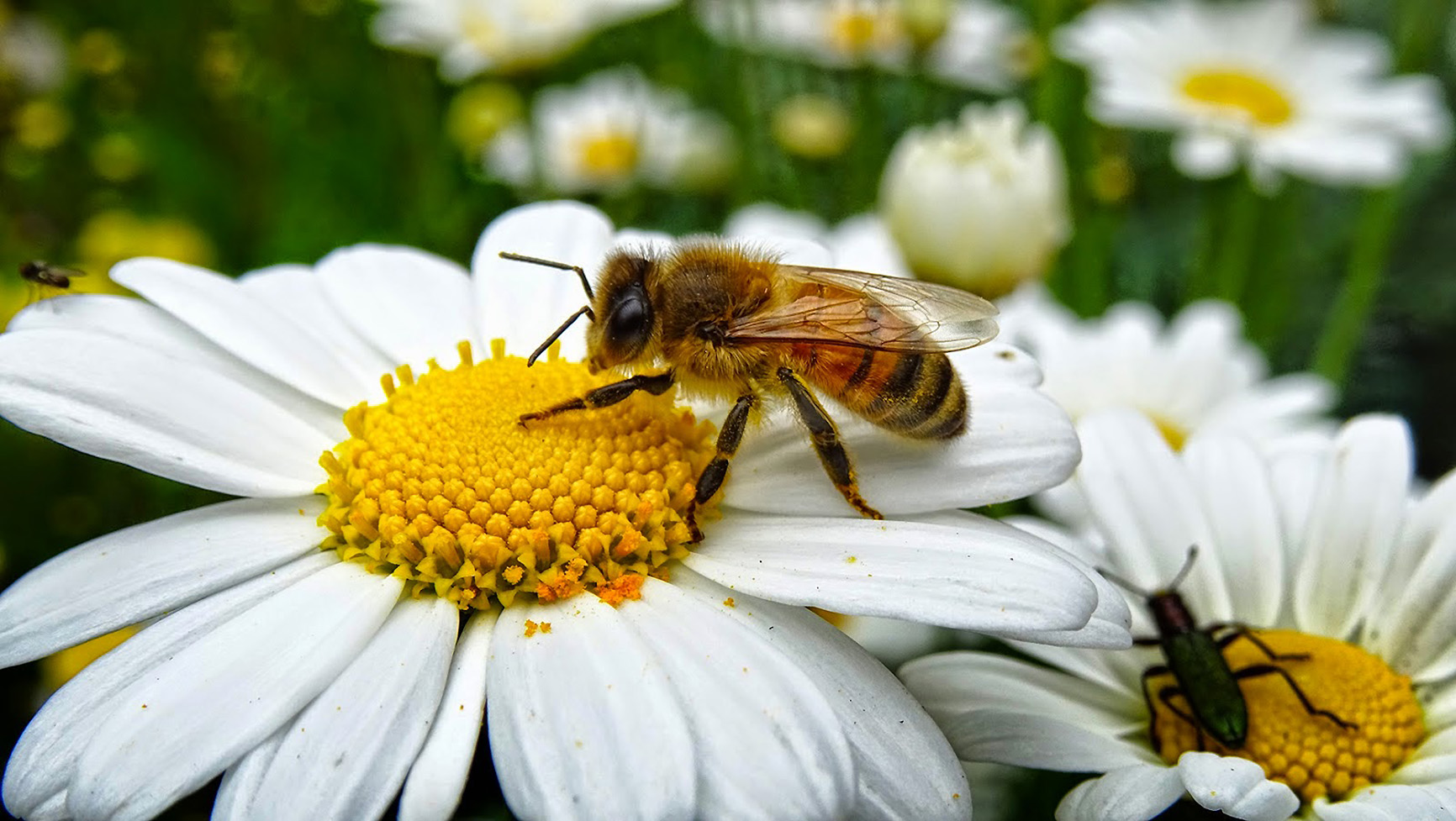
A bee feasting on a Shasta daisy, Leucanthemum × superbum. The Shasta daisy, is a commonly grown flowering herbaceous perennial plant with the classic daisy appearance of white petals (ray florets) around a yellow disc, similar to the oxeye daisy Leucanthemum vulgare (Lam), but larger.

It originated as a hybrid produced in 1890 by the American horticulturist Luther Burbank from a number of daisies. First, he crossed Leucanthemum vulgare with Leucanthemum maximum; this double hybrid was itself crossed with Leucanthemum lacustre. The resulting Leucanthemum triple hybrid was crossed with Nipponanthemum nipponicum, creating an intergeneric cross of species from three continents.

It was named after Mount Shasta, because its petals were the colour of the snow. Some members of the genus are considered noxious weeds, but the Shasta daisy remains a favourite garden plant.

Join me for Floral Friday Fotos by linking your flower photos below, and please leave a comment once you have done so! If you link your post here, please show a link back to this site on your blog post.

You are invited to the Inlinkz link party!

Click here to enter

Thursday, 16 June 2022

FFF549 - CELOSIA

Celosia is a small genus of edible and ornamental plants in the amaranth family, Amaranthaceae. The generic name is derived from the Greek word κηλος (kelos), meaning "burned," and refers to the flame-like flower heads. Species are commonly known as woolflowers, or, if the flower heads are crested by fasciation, cockscombs. The plants are well known in East Africa’s highlands and are used under their Swahili name, mfungu.

Celosia 'Intenz' (Celosia caracus) seen here, has a vibrant magenta colour on spiky blooms and sought-after texture to add to mixed containers. 'Intenz' is also versatile, able to be planted in patio pots, landscapes or used as a pot plant indoors. It performs well in full-sun with a long flowering time for home gardeners. It is a low-maintenance plant with high appeal.

Join me for Floral Friday Fotos by linking your flower photos below, and please leave a comment once you have done so! If you link your post here, please show a link back to this site on your blog post.


You are invited to the Inlinkz link party!

Click here to enter