The rules for posting are simple!

1. Every Friday post a photo that includes one or more flowers.
2. Please only post photos you have authority to use.
3. Include a link to this blog in your post - http://floralfridayfoto.blogspot.com/
4. Leave the link to your FloralFridayFoto post below on inlinkz.
5. Visit other blogs listed ... comment & enjoy!

When to Post:
inlinkz will be available every Thursday and will remain open until the next Wednesday.
Showing posts with label insect. Show all posts

Thursday, 8 December 2016

FFF263 - BUTTERFLY & ROSES

Pieris rapae, the small white, is a small- to medium-sized butterfly species of the whites-and-yellows family Pieridae. It is also known as the small cabbage white and in New Zealand, simply as white butterfly. The names "cabbage butterfly" and "cabbage white" can also refer to the large white. The butterfly can be distinguished by the white colour with small black dots on its wings. They are distinguished from the smaller size and lack of the black band at the tip of their forewings.

It is widespread and populations are found across Europe, North Africa, Asia, South America, and Great Britain. It has also been accidentally introduced to North America, Australia and New Zealand. The caterpillar of this species is seen as a pest for commercial agriculture. Often referred to as the "imported cabbageworm" they are a serious pest to cabbage and other mustard family crops.

The pink rose is a nameless variety that is in our neighbour's garden and is bushy, a prolific bloomer and can become rather messy with spent flowers, requiring generous deadheading. Nevertheless, it can be quite pretty when blooming with masses of small semi-double blossoms.

Join me for Floral Friday Fotos by linking your flower photos below, and please leave a comment once you have done so!
****If you take part in the meme, please show an active link back to this site on your own blog post!****

Thursday, 30 July 2015

FFF193 - INFESTATION!

Aphids, also known as plant lice and in Britain and the Commonwealth as greenflies, blackflies, or whiteflies (not to be confused with "jumping plant lice" or true whiteflies), are small sap-sucking insects, and members of the superfamily Aphidoidea. Aphids are among the most destructive insect pests on cultivated plants in temperate regions. The damage they do to plants has made them enemies of farmers and gardeners the world over, though from a zoological standpoint they are a highly successful group of organisms.

Their success is due in part to the asexual reproductive capabilities of some species. About 4,400 species are known, all included in the family Aphididae. Around 250 species are serious pests for agriculture and forestry as well as an annoyance for gardeners. They vary in length from 1 to 10 millimetres. Natural enemies include predatory ladybirds, hoverfly larvae, parasitic wasps, aphid midge larvae, crab spiders, lacewings, and entomopathogenic fungi such as Lecanicillium lecanii and the Entomophthorales.

There are various insecticides that can be used to control aphids, including synthetic insecticides and plant extracts/products that are thought to be more eco-friendly. For example, neem and lantana products can be used to protect plants against aphids. For small backyard infestations, simply spraying the plants thoroughly with a strong water jet every few days may be sufficient protection for roses and other plants. An insecticidal soap solution can be an effective household remedy to control aphids and other soft-bodied arthropods. It will only kill aphids on contact and has no residual action against aphids that arrive after application. Soap spray may damage plants, especially at higher concentrations or at temperatures above 32 °C. Some plant species are known to be sensitive to soap sprays.

Integrated pest management of various species of aphids can be achieved using biological insecticides based on fungi such as Lecanicillium lecanii, Beauveria bassiana or Paecilomyces fumosoroseus. Aphids may also be controlled by the release of natural enemies, in particular lady beetles and parasitic wasps. However, since adult lady beetles tend to fly away within 48 hours after release, without laying eggs, it requires repeated application of large numbers of lady beetles to be effective. For example, one large, heavily infested rose bush may take two applications of 1500 beetles each. In reality the only cost effective situation in which mass release of natural enemies makes sense is in closed or semi closed environments such as glasshouses or polytunnels.

This post is also part of the Friday Greens meme.

Join me for Floral Friday Fotos by linking your flower photos below, and please leave a comment once you have done so.
***If you take part in the meme, please show an active link back to this site on your own blog post!***

Thursday, 23 August 2012

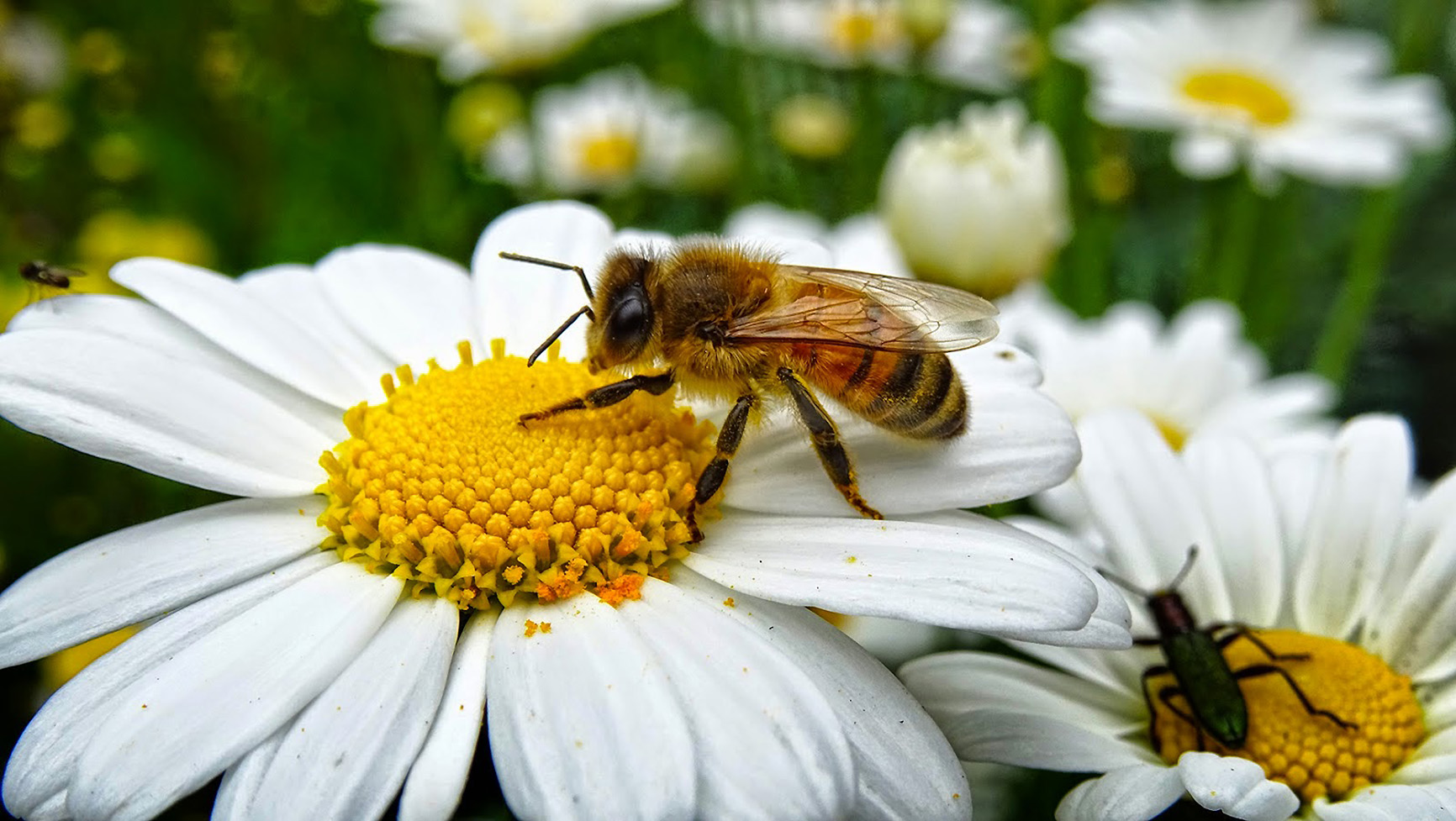
FFF40 - WHERE THE BEE SUCKS...

Honey bees are a subset of bees in the genus Apis, primarily distinguished by the production and storage of honey and the construction of perennial, colonial nests out of wax. Honey bees are the only extant members of the tribe Apini, all in the genus Apis. Currently, there are only seven recognised species of honey bee with a total of 44 subspecies, though historically, anywhere from six to eleven species have been recognised. Honey bees represent only a small fraction of the approximately 20,000 known species of bees. Some other types of related bees produce and store honey, but only members of the genus Apis are true honey bees.

Most species have historically been cultured or at least exploited for honey and beeswax by humans indigenous to their native ranges. Only two of these species have been truly domesticated, one (Apis mellifera) at least since the time of the building of the Egyptian pyramids, and only that species has been moved extensively beyond its native range. Species of Apis are generalist floral visitors, and will pollinate a large variety of plants, but by no means all plants. Of all the honey bee species, only Apis mellifera has been used extensively for commercial pollination of crops and other plants. The value of these pollination services is commonly measured in the billions of dollars.

Join me for Floral Friday Fotos by linking your flower photos below, and please leave a comment once you have done so!

Thursday, 28 June 2012

FFF32 - HYACINTH

Hyacinthus is a small genus of bulbous flowering plants in the family Asparagaceae, subfamily Scilloideae. Plants are commonly called hyacinths. Hyacinthus is native to the eastern Mediterranean (from south Turkey to northern Israel), north-east Iran, and Turkmenistan.

Three species are within the genus Hyacinthus:
Hyacinthus litwinowii
Hyacinthus orientalis - Common, Dutch or Garden Hyacinth
Hyacinthus transcaspicus.

Some authorities place H. litwonowii and H. transcaspicus in the related genus Hyacinthella, which would make Hyacinthus a monotypic genus.The Dutch, or Common Hyacinth of house and garden culture (H. orientalis, native to southwest Asia) was so popular in the 18th century that over 2,000 cultivars were cultivated in the Netherlands, its chief commercial producer.

This hyacinth has a single dense spike of fragrant flowers in shades of red, blue, white, orange, pink, violet, or yellow. A form of the common hyacinth is the less hardy and smaller blue- or white-petalled Roman hyacinth of florists. These flowers should have indirect sunlight and are to be moderately watered.Several types of brodiea, squill, and other plants that were formerly classified in the lily family and have flower clusters borne along the stalk also have common names with hyacinth in them.

Hyacinths should also not be confused with the genus Muscari, which are commonly known as grape hyacinths.Hyacinths are sometimes associated with rebirth. The Hyacinth flower is used in the Haftseen table setting for the Persian New Year celebration Norouz held during the Spring Equinox. Hyacinth bulbs are poisonous; they contain oxalic acid. Handling hyacinth bulbs can cause mild irritation to people with sensitive skin. Protective gloves may be worn to avoid irritation.


Join me for Floral Friday Fotos by linking your flower photos below, and please leave a comment once you have done so! 

Thursday, 7 June 2012

FFF29 - ECHINACEA

Echinacea is a genus of herbaceous flowering plants in the daisy family, Asteraceae. The nine species it contains are commonly called purple coneflowers. They are endemic to eastern and central North America, where they are found growing in moist to dry prairies and open wooded areas.

They have large, showy heads of composite flowers, blooming from early to late summer. The generic name is derived from the Greek word ἐχῖνος (echinos), meaning "sea urchin," due to the spiny central disk. Some species are used in herbal medicines and some are cultivated in gardens for their showy flowers. A few species are of conservation concern.

Join me for Floral Friday Fotos by linking your flower photos below, and please leave a comment once you have done so!

Wednesday, 18 January 2012

FFF9 - MAGNOLIA GRANDIFLORA

Magnolia grandiflora is an evergreen tree which grows to a height of 10m and a width of 10m, native to South-eastern N. America - North Carolina to Florida and Texas. It has a moderate growth rate. In Australia, Magnolia grandiflora will flower in December to March with the seeds ripening from March to May. The large, showy, fragrant white flowers from this plant are hermaphrodite (both male and female reproductive organs) and they are pollinated by beetles.

The name magnolia was coined in recognition of Pierre Magnolia, the French Botanist (1638-1715). Magnolias are considered to be an ancient flowering plant bearing the largest individual flowers of any tree or shrub that can be cultivated in temperate climates.

Please join me for Floral Friday Fotos by linking your flower photos below.


Wednesday, 14 December 2011

FFF4 - BUTTERFLY FEASTING ON LANTANA

Lantana is a genus of about 150 species of perennial flowering plants in the verbena family, Verbenaceae. They are native to tropical regions of the Americas and Africa but exist as an introduced species in numerous areas, especially in the Australian-Pacific region. The genus includes both herbaceous plants and shrubs growing to 0.5–2 m (1.6–6.6 ft) tall. Their common names are shrub verbenas or lantanas. The generic name originated in Late Latin, where it refers to the unrelated Viburnum lantana. This is a Lantana camara in our garden, which this butterfly is finding particularly tempting.


Sunday, 4 December 2011

FFF3 - BEE ON LAVENDER FLOWER

Italian lavender (Lavandula pedunculata) is very attractive to bees and photographing the interaction of bee and flower is always rewarding!

Please join us and share your flower photos every Friday!