The rules for posting are simple!
2. Please only post photos you have authority to use.
3. Include a link to this blog in your post - http://floralfridayfoto.blogspot.com/
4. Leave the link to your FloralFridayFoto post below on inlinkz.
5. Visit other blogs listed ... comment & enjoy!
When to Post:
inlinkz will be available every Thursday and will remain open until the next Wednesday.
Thursday, 27 June 2024
FFF653 - CORREA
Thursday, 5 October 2023
FFF615 - GRAPEFRUIT FLOWERS
You are invited to the Inlinkz link party!
Click here to enterThursday, 15 June 2023
FFF599 - RUEFUL BEE
You are invited to the Inlinkz link party!
Click here to enterThursday, 3 March 2022
FFF534 - CROWEA
You are invited to the Inlinkz link party!
Click here to enterThursday, 30 December 2021
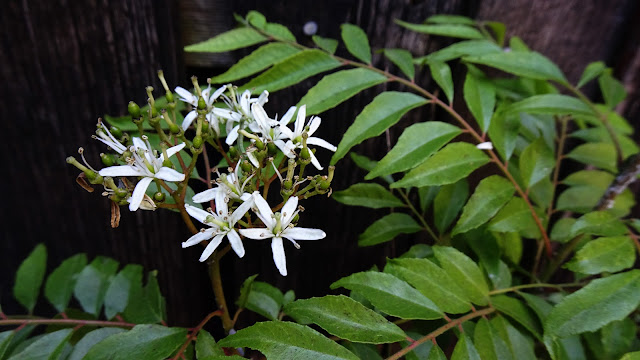
FFF525 - CURRY TREE
The curry tree, Murraya koenigii or Bergera koenigii, is a tropical to sub-tropical tree in the family Rutaceae (the rue family, which includes rue, citrus, and satinwood), and is native to Asia. The plant is also sometimes called sweet neem, though M. koenigii is in a different family to neem, Azadirachta indica, which is in the related family Meliaceae. Its leaves, known as curry leaves, are used in many dishes in the Indian subcontinent.
You are invited to the Inlinkz link party!
Click here to enterThursday, 1 July 2021
FFF499 - KUMQUAT
You are invited to the Inlinkz link party!
Click here to enterThursday, 20 February 2020
FFF429 - WAX FLOWER
You are invited to the Inlinkz link party!
Click here to enterThursday, 22 August 2019
FFF403 - WAX FLOWER,
You are invited to the Inlinkz link party!
Click here to enterThursday, 23 May 2019
FFF390 - CORREA
You are invited to the Inlinkz link party!
Click here to enterThursday, 5 July 2018
FFF345 - CHOISYA
Thursday, 17 May 2018
FFF338 - BORONIA
Thursday, 1 June 2017
FFF288 - CORREA 'DUSKY BELLS'
Correa reflexa, a parent species of Correa ‘Dusky Bells’, ranges from southern Queensland, New South Wales, Victoria, eastern South Australia and Tasmania. Correa pulchella is pretty much restricted to South Australia. Both of the parent species are mostly distributed in temperate regions. Therefore, it can be inferred that Correa ‘Dusky Bells’ is not likely to grow well in the hot tropics such as northern Queensland.
It is an attractive evergreen shrub which grows to 1m high and to 2-4 m in diameter. The entire plant is stellate hairy. Leaves have stellate hairs and the older leaves lose hairs. The leaves are to 4.5 cm long, and 2.5 cm wide; narrow oval (elliptic) or lance-shaped (lanceolate) to egg-shaped leaf (ovate). The beautiful bell-shaped flowers are up to 2.5cm long. The four fused petals are pale carmine pink.
Hybrid Correas have a tendency to be more compact and heavy flowering than the wild species, which makes them a desirable gardening plant. Correa ‘Dusky Bells’ is drought and frost tolerant. It is great for a shaded environment. It prefers somewhat shady situations rather than full sun. It also attracts birds to the gardens. Many of the Correa species are pollinated by birds such as honey eaters as it normally has a lot of nectar. Flowering time is from March to September. However, it also flowers sporadically displaying its lovely bell-shaped flowers throughout a year.
In general, growing Correa ’Dusky Bells’ is easy. It prefers moist soil, though it is drought tolerant. It grows wells on friable, well-drained and fertile loam. Propagation of this plant is possible by cutting. If it grows tall or wide, you can prune the plant. Regular pruning is good for the plant. It is best to avoid humid areas. Scale infestation of Correa due to insidious black smut was reported, but it is not common. Correa ‘Dusky Bells’ is an excellent evergreen garden plant. It is easy-to-grow, drought and frost tolerant and beautiful.
I appreciate your linking up and enjoy personally seeing your great photos, however, due to a work-related busy time I may have not commented lately - I shall endeavour to do so ASAP!
Thursday, 20 March 2014
FFF122 - MEXICAN ORANGE
Choisya species are popular ornamental plants in areas with mild winters, grown primarily for their abundant and fragrant flowers. The foliage is also aromatic, smelling of rue when bruised or cut. The most commonly found cultivars in the horticultural trade are the species, C. ternata (shown here), the golden-leaved C. ternata 'Sundance', and the inter-specific hybrid C. 'Aztec Pearl' (C. arizonica x C. ternata). All three varieties have gained the Royal Horticultural Society's Award of Garden Merit. The flowers are also valued for honeybee forage, producing abundant nectar.
Join me for Floral Friday Fotos and please leave a comment once you contribute.
Thursday, 3 October 2013
FFF98 - ORANGE BLOSSOM
It is traditionally associated with good fortune and has been popular in bridal bouquets and head wreaths for weddings. Orange blossom essence is an important component in the making of perfume. The petals of orange blossom can also be made into a delicately citrus-scented version of rosewater; orange blossom water (aka orange flower water), a common part of both French cuisine and Middle Eastern cuisine (most often as an ingredient in desserts and baked goods).
In the United States, orange flower water is used to make orange blossom scones and marshmallows. Orange blossom honey (citrus honey) is produced by putting beehives in the citrus groves during blooming period. This also pollinates seeded citrus varieties. Orange blossom honey is highly prized and tastes much like the fruit.
Join me for Floral Friday Fotos by linking your flower photos below, and please leave a comment once you have done so!
Thursday, 21 February 2013
FFF66 - CROWEA EXALATA
This species flowers during most months of the year, resting only in extremes of heat and cold, and with flushes in autumn and spring. Pointed buds open to five-petalled starry flowers 2 cm across, in clear tints of rose purple. They are of a solid waxy substance, and make a vivid display for the size of the plant. Before falling they close again to look like buds of deeper pink. Propagation by cuttings is easy using tip growth (which is very soft in character), at a half-ripe stage.
Nurseries dealing in native plants usually stock this small shrub and it should be planted in light, lime-free soil. A position with some shade is desirable - otherwise the soil should be shaded in some way from hot sun. This may be done by surrounding the plant with 5-10 cm of leaves, bush litter or compost. Rocks make an attractive setting, and in fact this is a beautiful rockery subject. Pruning should be done to maintain bushy growth, or a straggly plant with bare stems may develop. The end of winter is a good time to do this - or any time when sprigs of cut flowers are wanted, as these are dainty and long-lasting in water.
Join me for Floral Friday Fotos by linking your flower photos below, and please leave a comment once you have done so!