The rules for posting are simple!

1. Every Friday post a photo that includes one or more flowers.
2. Please only post photos you have authority to use.
3. Include a link to this blog in your post - http://floralfridayfoto.blogspot.com/
4. Leave the link to your FloralFridayFoto post below on inlinkz.
5. Visit other blogs listed ... comment & enjoy!

When to Post:
inlinkz will be available every Thursday and will remain open until the next Wednesday.
Showing posts with label Passifloraceae. Show all posts

Thursday, 22 September 2022

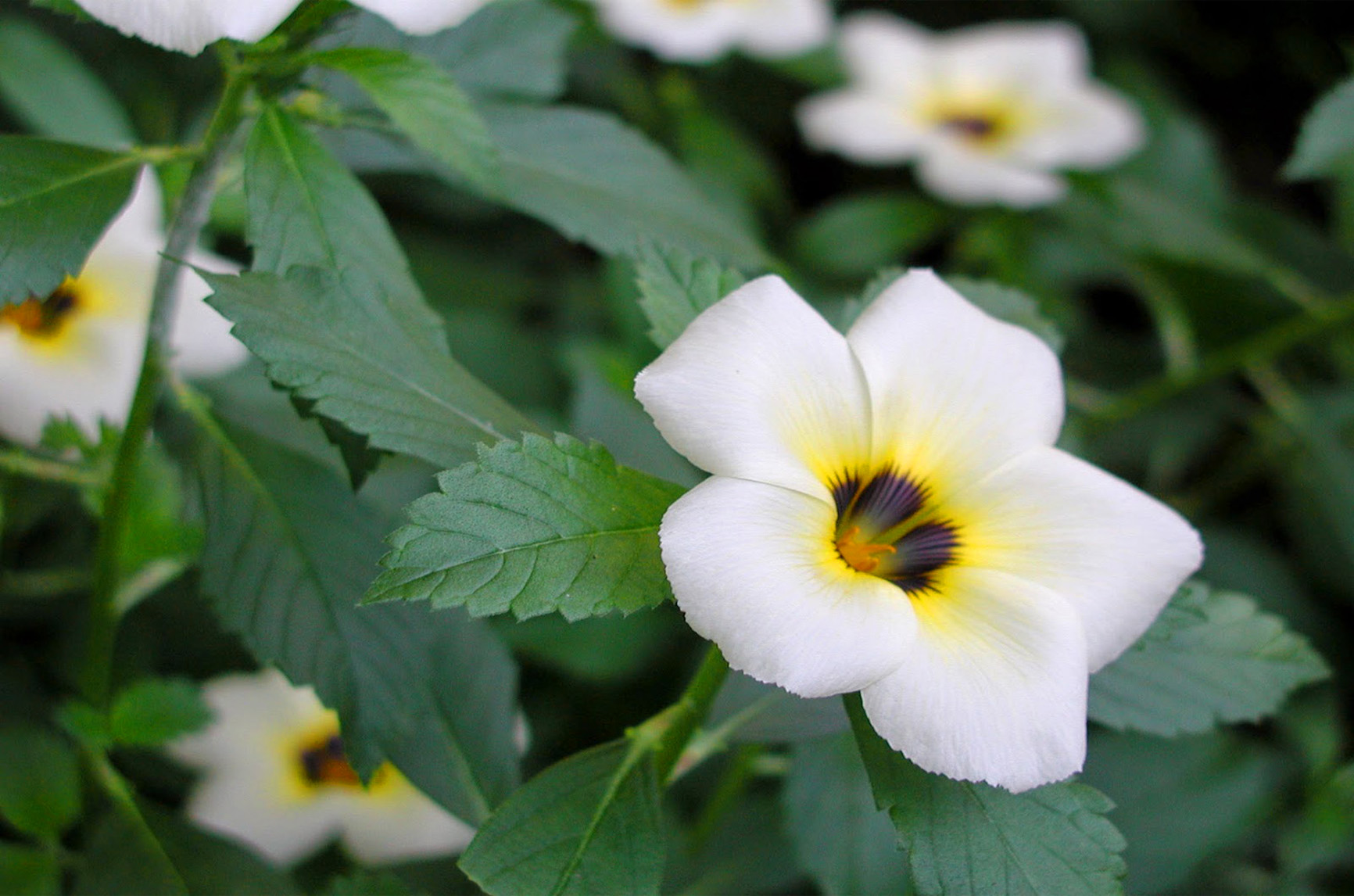
FFF561 - TURNERA

Turnera subulata is a species of flowering plant in the Passifloraceae family known by the common names white buttercup, sulphur alder, politician's flower, dark-eyed turnera, and white alder. Despite its names, it is not related to the buttercups or the alders. It is native to Central and South America, from Panama south to Brazil. It is well known in many other places as an introduced species, such as Malaysia, Indonesia, several other Pacific Islands, the Caribbean, and Florida in the United States. It is commonly cultivated as a garden flower.

This plant is a perennial herb growing from a thick taproot and woody stem base. It reaches a maximum height around 80 cm. The leaves are roughly oval in shape with toothed edges. The undersides are glandular and coated in white hairs. The upper surfaces may be somewhat hairy, as well. The leaves are up to 9 cm long. Flowers occur in the leaf axils, borne in calyces of hairy, glandular sepals. The petals are rounded to oval, the longest exceeding 3 cm. They are white or yellowish with darker bases. The dark patches at the bases are nectar guides. The centre of the flower is rough, said to feel like a cat's tongue.

The fruit is a hairy capsule containing seeds with white arils. The seeds are dispersed by ants, who are likely attracted to their high lipid content. This plant has uses in traditional medicine. It is used for skin, gastrointestinal, and respiratory ailments. In Brazil, the plant is made into cough syrup, and the roots are said to be good for dysmenorrhea. Laboratory tests showed it has some inhibitory activity against various fungi, such as Candida glabrata, Aspergillus flavus, A. niger, A. fumigatus, Penicillium chrysogenum, and Candida albicans.

Join me for Floral Friday Fotos by linking your flower photos below, and please leave a comment once you have done so!
****If you take part in the meme, please show an active link back to this site on your own blog post!****
You are invited to the Inlinkz link party!

Click here to enter

Thursday, 26 December 2019

FFF421 - PASSIONFLOWERS

Passiflora, known also as the passion flowers or passion vines, is a genus of about 500 species of flowering plants, the namesakes of the family Passifloraceae. They are mostly vines, with some being shrubs, and a few species being herbaceous. The monotypic genus Hollrungia seems to be inseparable from Passiflora, but further study is needed.

Nine species of Passiflora are native to the USA, found from Ohio to the north, west to California and south to the Florida Keys. Most other species are found in South America, Eastern Asia, and Southern Asia, New Guinea, four or more species in Australia and a single endemic species in New Zealand. New species continue to be identified: for example, P. pardifolia and P. xishuangbannaensis have only been known to the scientific community since 2006 and 2005, respectively.

Some species of Passiflora have been naturalised beyond their native ranges. For example, Blue Passion Flower (P. caerulea) now grows wild in Spain. The purple passionfruit (P. edulis) and its yellow relative P. flavicarpa have been introduced in many tropical regions as commercial crops. A number of species of Passiflora are cultivated outside their natural range because of their beautiful flowers. Hundreds of hybrids have been named; hybridising is currently being done extensively for flowers, foliage and fruit.

Join me for Floral Friday Fotos by linking your flower photos below, and please leave a comment once you have done so!
***If you take part in the meme, please show an active link back to this site on your own blog post!****
Add your own link to the Linky list below and say hello in a comment. Please visit other participants in the meme.

You are invited to the Inlinkz link party!
Click here to enter